

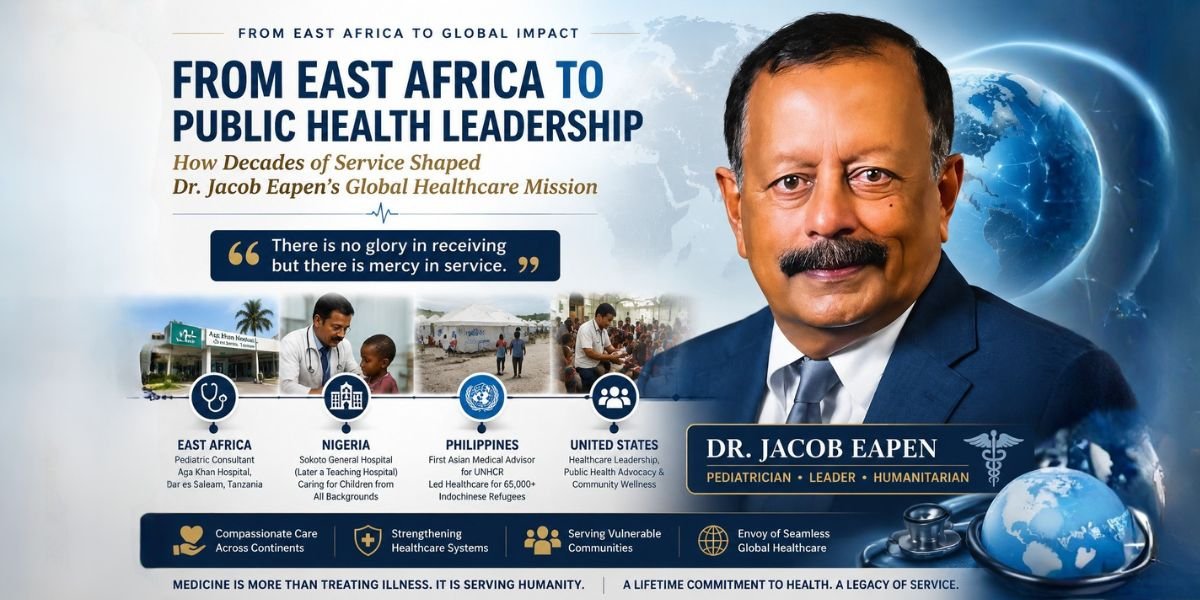
For more than three decades, Dr. Jacob Eapen has devoted his career to improving healthcare across multiple continents. His professional journey has taken him from hospitals in East Africa to public health leadership in the United States, with each stage reinforcing a lifelong commitment to serving vulnerable communities through medicine, education, and public service.
While healthcare systems, cultures, and challenges varied from country to country, one principle consistently guided his work.
“There is no glory in receiving, but there is mercy in service.”
That philosophy became especially meaningful during some of the most demanding years of his medical career.
After completing his medical training, Dr. Eapen served as a pediatric consultant at Aga Khan Hospital in Dar es Salaam, Tanzania. During this period, the hospital was closely associated with numerous diplomatic missions, allowing him to care for children from diplomatic families representing various nations. His work placed him in an international medical environment where delivering high-quality pediatric care required both clinical expertise and cultural understanding.
His time in Tanzania also carried personal challenges. His son was born there during a period when both his wife and newborn were affected by malaria. Experiencing these circumstances firsthand strengthened his understanding of the realities faced by countless families living in regions where infectious diseases remain a daily concern.
Based on recommendations from the Nigerian Ambassador to Tanzania, Dr. Eapen accepted an opportunity to join Sokoto General Hospital in Nigeria, which later evolved into a teaching hospital. Working in northwestern Nigeria presented an entirely new set of medical and environmental challenges. The region regularly experiences Harmattan, seasonal dust storms originating from the Sahara Desert, creating additional health complications for patients, particularly children with respiratory illnesses.
During this period, Dr. Eapen was entrusted with caring for the children of Nigeria’s then-President, Shehu Shagari, as well as the grandchildren of the Sultan of Sokoto, one of the country’s most respected traditional and religious leaders. While these responsibilities reflected the confidence placed in his medical expertise, his daily work remained focused on caring for children from all backgrounds.
Following his work in Nigeria, Dr. Eapen was appointed by the United Nations High Commissioner for Refugees (UNHCR) as a Medical Advisor in the Philippines. Based in the refugee camps of Bataan and Palawan, he directed healthcare services for approximately 65,000 Indochinese refugees. In this capacity, he coordinated medical and public health initiatives involving more than 20 non-governmental organizations (NGOs), including the Philippine National Red Cross and the International Organization for Migration (IOM). This humanitarian assignment further strengthened his expertise in refugee healthcare, preventive medicine, disease control, and large-scale public health coordination.
At a time when childhood mortality rates across many parts of Sub-Saharan Africa remained significantly high, pediatric medicine demanded exceptional dedication. Physicians frequently worked with limited resources while confronting infectious diseases, malnutrition, and preventable illnesses that affected thousands of families. Dr. Eapen has often described those years as among the most mentally and physically demanding of his career, yet also among the most rewarding because of the opportunity to make a meaningful difference in children’s lives.
These international experiences became foundational to his broader understanding of healthcare beyond hospital walls. They reinforced the importance of prevention, community health, public education, and equitable access to medical services, principles that would later define his leadership roles in public health administration.
After relocating to the United States, Dr. Eapen continued expanding his impact through clinical practice, healthcare administration, and public service. His work has included leadership responsibilities focused on improving pediatric care, preventive health initiatives, and community health programs while advocating for stronger healthcare systems that serve diverse populations.
His career demonstrates how global medical experience can inform local healthcare leadership. Lessons learned while treating patients in resource-constrained environments continue to influence his approach to public health, emphasizing prevention, collaboration, and long-term community wellbeing.
Throughout his professional journey, Dr. Eapen has remained committed to the belief that medicine extends beyond treating illness. Whether caring for children in East Africa or contributing to healthcare policy and community health initiatives in California, his focus has consistently centered on serving people with compassion, integrity, and purpose.
As healthcare continues to evolve worldwide, Dr. Eapen’s career serves as an example of how international experience, public service, and patient-centered care can collectively shape a lasting contribution to the medical profession. He has also served as an Envoy of Seamless Global Healthcare, further reflecting his continued commitment to advancing international collaboration and improving access to healthcare worldwide.