


Here Is What AI App Development Actually Requires
The conversation around AI in mobile apps has matured past the hype phase. Two years ago, the founders were debating whether to add AI to their product. Today, they are asking how to do it without building something brittle, expensive to maintain, and impossible to explain to a user. The market has moved. The standard has shifted. And the development teams that understand how to build AI-powered applications with architectural integrity are the ones worth working with.
Appsters was built for exactly this moment. Trusted by CTOs and designed for AI scalability from the ground up, the team has been thinking about intelligent application architecture since before it became the default selling point on every agency website.
The Difference Between AI-Washed and AI-Powered
There is a meaningful distinction between an app that slaps a chatbot on a screen and calls itself AI-powered, and one where machine learning genuinely shapes the user experience. The first type is everywhere. The second requires a development partner who understands model integration, data pipeline architecture, inference latency, and the user experience implications of each.
AI-powered applications make decisions. They personalize content, surface relevant information before the user thinks to ask for it, automate workflows that previously required manual input, and learn from interaction patterns to become more useful over time. That kind of intelligence does not come from dropping an API call into an existing codebase. It comes from designing the application with intelligence as a core pillar from the first sprint.
What AI App Development Looks Like in a Production Context?
A well-built AI application starts with a clear definition of the problem the intelligence is meant to solve. Not ‘we want AI in the app’ but ‘we want the app to recommend the next action before the user navigates to find it’ or ‘we want the system to flag anomalous behavior without a human reviewing every record.’ The specificity matters because it determines which models are appropriate, what data needs to be collected and structured, and how the inference layer integrates with the rest of the product.
Appsters approaches AI app development with that specificity as a prerequisite. The team works through the product goals before recommending a technical approach, because the right AI solution for a fitness app is categorically different from that for a logistics platform or a social media tool. The model matters. The training data matters. The latency budget matters. None of these decisions should be made by default.
On-Device vs. Cloud Inference: A Decision That Shapes Everything
One of the most consequential architectural decisions in AI app development is where the inference happens. Cloud-based inference offers power and flexibility but introduces latency and dependency on connectivity. On-device inference runs faster and works offline, but is constrained by the hardware’s processing capabilities.
For consumer mobile apps, this trade-off is not academic. It affects how quickly the app responds, how it behaves in low-signal environments, and how much the ongoing infrastructure costs to run. Appsters navigates this decision with experience rather than ideology, recommending the approach that fits the specific product’s needs rather than defaulting to whatever is easiest to implement.
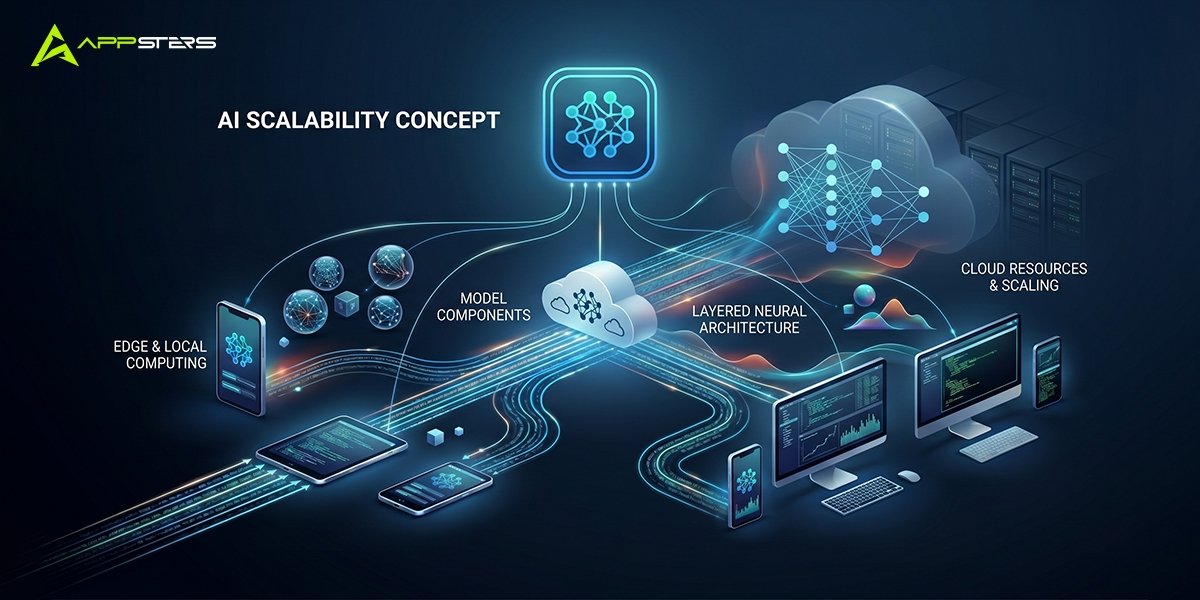
Scalability in the Context of AI: Why It Is More Complex Than Standard Apps
An AI-powered application that works beautifully for a thousand users can degrade ungracefully at a hundred thousand if the infrastructure was not designed to scale. Model inference at volume is not cheap. Data pipelines that feed learning systems require careful architecture to remain performant as data grows. And the feedback loops that make AI systems improve over time need to be designed explicitly, not assumed.
Appsters builds AI applications with this trajectory in mind. The infrastructure is sized not for where the product is at launch but for where it needs to be in twelve months. That means thinking about model versioning, retraining pipelines, cost controls on inference, and the monitoring systems needed to catch degraded performance before users notice it.
Security, Privacy, and the Trust Equation
AI applications collect and process more user data than standard apps, and users are increasingly aware of this. The trust equation has shifted. Products that handle data carelessly pay for it in reviews, churn, and regulatory attention. The best AI app development practices build privacy considerations into the architecture from the beginning, not as a compliance exercise but as a product differentiator.
Appsters treats data privacy as a design constraint, not an afterthought. How data is collected, what is stored versus processed in transit, how user consent is communicated, and how data is handled if a user requests deletion are questions the team addresses during scoping, not after launch.
Why Appsters Is the Right Partner for AI App Development?
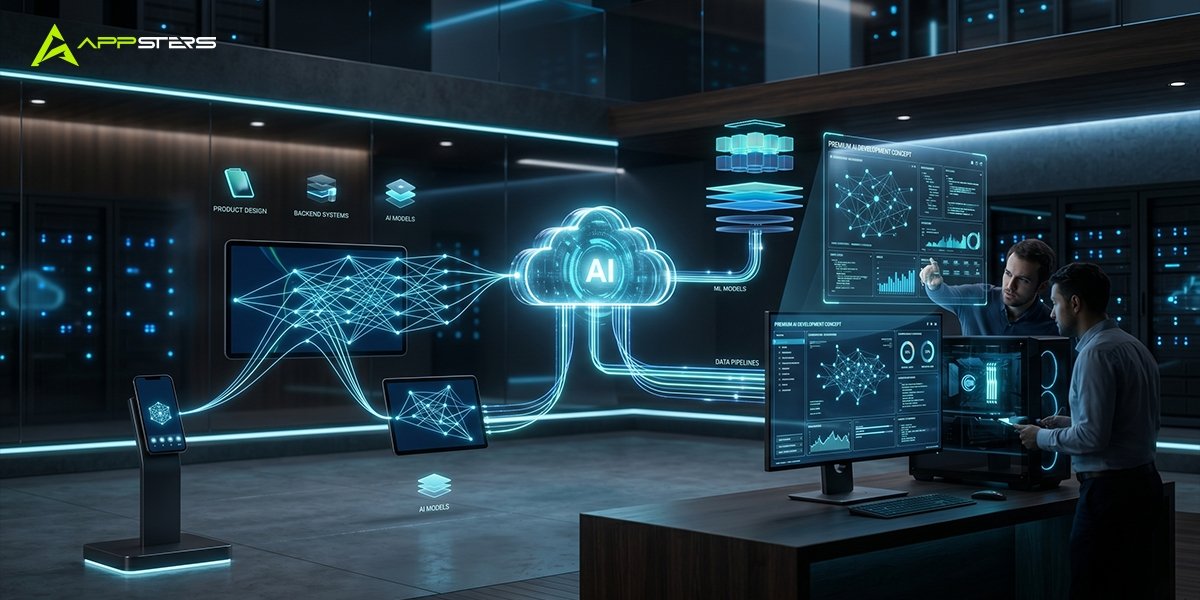
Building an AI-powered application is a fundamentally different challenge from building a standard mobile product. It requires expertise spanning product design, backend engineering, machine learning operations, and user experience. Most agencies have depth in one or two of these areas. Appsters has built a team that covers all of them because the projects that matter require them all.
As a sister brand of Cobweb Games and Cloud Animations, Appsters also brings something most AI development shops lack: a genuine understanding of how intelligent systems interact with human behavior in real time. Games have been doing this for decades. The lessons transfer directly to AI-powered consumer applications, and that cross-disciplinary perspective shows up in every product the team ships.
For any business serious about building an AI application that is genuinely intelligent, scalable, and built for the long term, the conversation starts at Appsters. The future of mobile is smart. The question is whether the app being built today is ready for it.
Intelligence Is an Architecture Decision
The apps that define the next decade will not be the ones with the most features. They will be the ones who understand their users deeply enough to get out of the way and deliver exactly what is needed, when it is needed, without friction. That kind of intelligence requires serious development thinking. It requires a team that has done it before and knows where the pitfalls live. Appsters builds those products. Reach out at www.appsters.io and start the conversation worth having.