
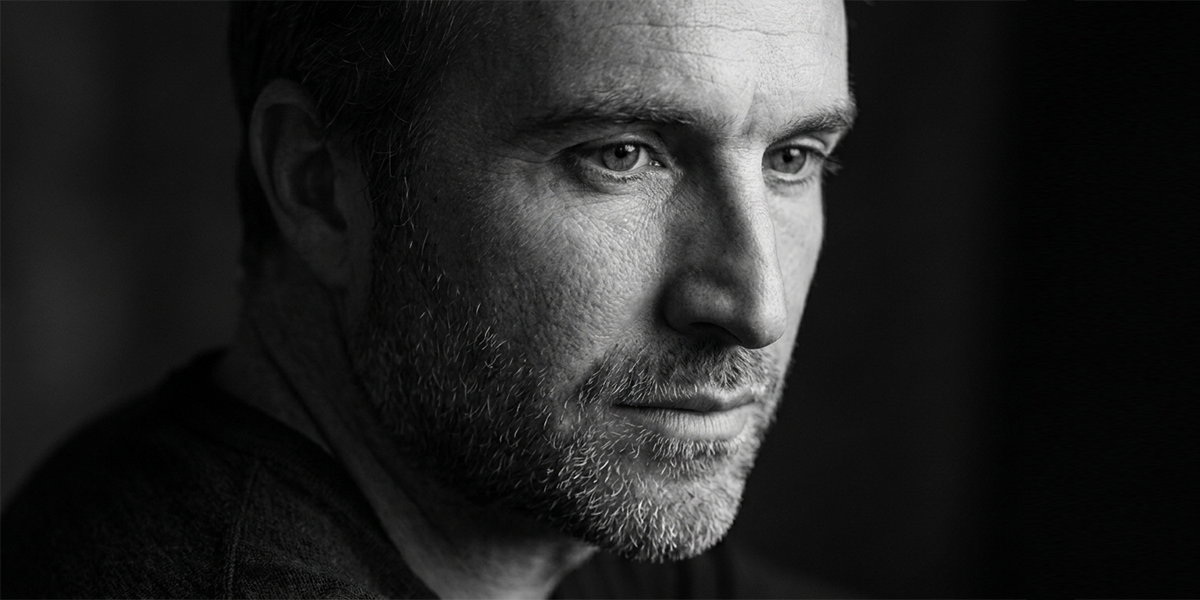
The Brazilian-born photographer who made the horse the subject of a global fine art career, and built the infrastructure to match.
The art market has a deep suspicion of the single-subject artist. Specialism, the received wisdom holds, is the enemy of range, and range is what galleries sell and critics celebrate. Raphael Macek has spent twenty-five years proving the opposite. By choosing one subject, the horse, and refusing to leave it, the Brazilian fine art photographer has built something the contemporary market rarely produces: a vertically integrated, globally distributed fine art empire anchored in a single, inexhaustible idea.
Today, Macek’s limited-edition prints are held in private collections across more than thirty countries. His work has appeared at over thirty international art fairs, including Paris Photo and Art Basel Miami. His galleries operate from Greenwich, Connecticut, to Dubai. His monograph, Equine Beauty, A Study of Horses, published by the German house teNeues, circulates in five languages. And his own archival printing studio, InnFRAME, based in South Florida, ensures that every object that leaves his name meets a standard he has personally inspected and approved.
The geography of that reach, New York, London, Paris, Miami, Dubai, Berlin, Madrid, Brussels, São Paulo, Singapore, Riyadh, Tokyo, is not the result of a single breakthrough moment. It is the accumulated consequence of a quarter century of methodical, uncompromising work.
The Global Footprint
Macek’s international presence did not begin at the top. It began, as most serious fine art careers do, with the slow accretion of credibility: solo exhibitions in Brazil, then in Europe, then across the Americas and the Gulf. More than twenty-five solo exhibitions now form the spine of that record. The international art fair circuit, thirty-plus inclusions, anchored by appearances at Paris Photo and Art Basel Miami, gave the work its global visibility. The monograph gave it permanence.
What distinguishes his distribution model from that of most photographers working at his level is the combination of gallery representation on three continents with consistent international pricing. Prices range from a $6,500 entry point for smaller works to more than $23,000 at the upper end of the size matrix. Editions are capped at twelve per size, each numbered, each signed. The market is liquid, the pricing is stable, and the secondary market has held its structure in a way that serious collectors and their advisors notice.
The collector base itself has become a kind of infrastructure. Distributed across more than thirty countries, it functions less like a list of buyers and more like an international community of patrons who recognise one another, in Palm Beach, in London, in Singapore, in Riyadh, and whose word-of-mouth, in a market where word-of-mouth is the only currency that ultimately matters, has done more for Macek’s reach than any single institutional endorsement.
“Their hooves leave the drawing, and their bodies are the artist’s brush.”
— Raphael Macek
The Work Behind the Empire
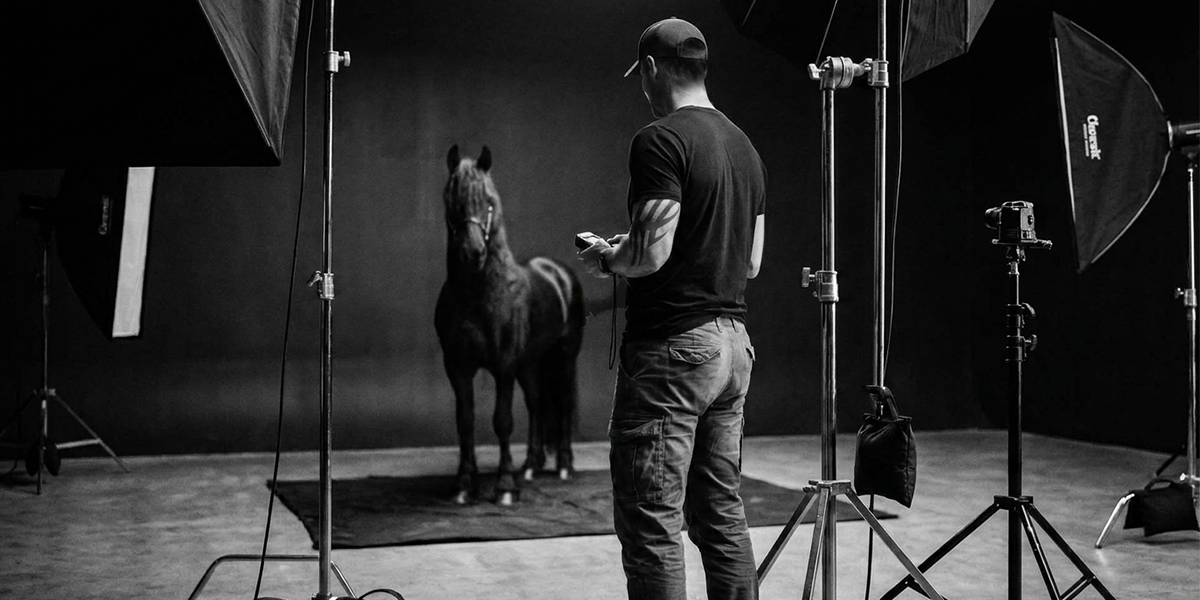
It would be easy, looking at the numbers, to miss the thing that made them possible: the work itself. Macek began photographing horses professionally twenty-five years ago, in natural light, in a country where almost no one was treating equine photography as fine art. He built his own studio techniques in an environment where, at the time, almost no photographer was producing horse portraiture under controlled conditions. He pursued a single visual objective, an image nobody had seen before, with what he describes as deliberate isolation, consciously avoiding the work of other equine photographers so that his visual vocabulary would remain entirely his own.
The result is immediately legible. There is no Stubbsian inheritance in the work, no sentimental equestrian tradition, no gesture toward the genre conventions that have dominated horse imagery for two centuries. The horses in Macek’s photographs are sculptural beings treated with the formal seriousness of a Brancusi, the lighting discipline of a master printer, and the tonal command of black-and-white photography at its most knowing.
His most recent collection, Over the Dunes, extended that discipline to its most ambitious terrain yet. Shot in the Emirates at dawn and dusk, the series returns Arabian horses, the world’s oldest breed, to the desert landscape that created them. The working method is monastic: Macek does not direct the horses, does not arrange them in the landscape, does not interfere with their behaviour. He waits, sometimes for hours, sometimes for days, until the moment arranges itself. The signature image of the collection, Arcus, shows a dark horse in the foreground whose legs form pillars, and through those pillars, in the far distance, a herd runs free across white dunes.
The Infrastructure
The empire, if it can be called that, rests on a foundation that most photographers never build. InnFRAME, Macek’s proprietary large-format archival printing studio in South Florida, is the final mile of a production chain that begins with Phase One IQ4 cameras, 150-megapixel sensors, the largest medium-format systems made for studio and field work, and ends with Hahnemühle 100% cotton rag paper, acid-free, with a permanence rating from Wilhelm Imaging Research that exceeds two hundred years. Mounting, when collectors elect for it, uses the Diasec face-mount process developed in Germany and used by some of the most exacting fine art photographers in the world.
This is what is meant, in the contemporary luxury market, by vertical integration. It is also a particular kind of artistic conviction: the insistence that the object a collector acquires is not merely an image, but a physical artifact that Macek has personally touched, inspected, and approved, a piece of a life’s work, documented in perpetuity.
The Position
The broader argument underpinning the empire is one that has grown more relevant by the month. Macek’s guiding philosophy, Real Will Always Be Rarer, holds that in an era of synthetic imagery produced at near-zero cost by machines that have never stood in a desert at four in the morning, the photograph that was actually made, by an actual human being, in an actual place, over twenty-five years of preparation, will not lose value. It will gain it. Scarcity, in an economy of fabrication, is the rarest commodity of all.
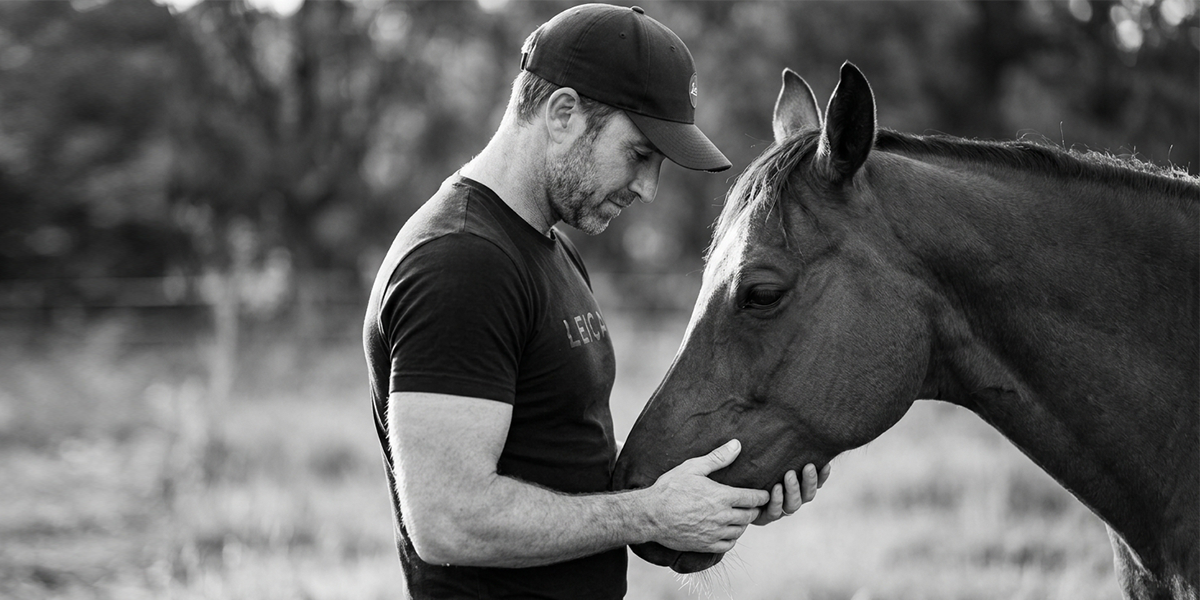
His parallel role as Official Creative Ambassador for American Wild Horse Conservation roots that commercial argument in something older and less transactional: the conviction that the horse, which made human civilisation possible, its exploration, its commerce, its agriculture, its military history, is owed a debt the species has not yet repaid. The conservation work is a form of repayment.
From New York to Dubai, from São Paulo to Singapore, the empire Macek has built is, at its core, the expression of a single idea pursued without interruption for a quarter of a century. The market, it turns out, rewards that kind of patience.
Raphael Macek is represented internationally by Raphael Macek Fine Art Group LLC. Acquisition and press inquiries: raphaelmacek.com · gallery@raphaelmacek.com