

By: Kyra Burns
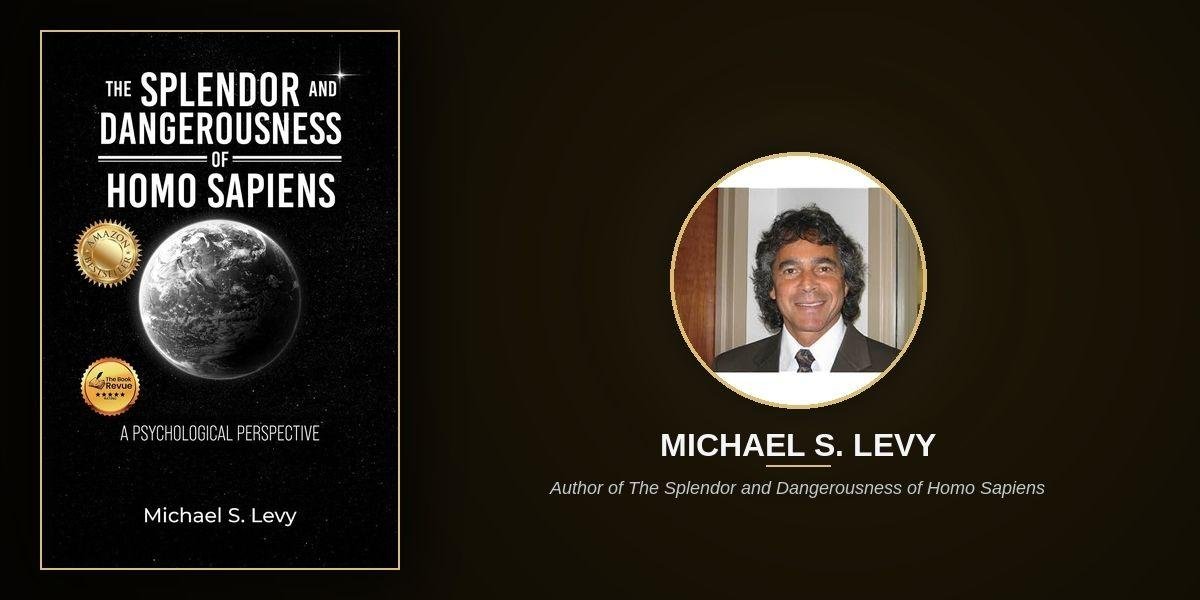
Yuval Noah Harari’s Sapiens and Robert Sapolsky’s Behave represent two of the most significant attempts of recent decades to understand the human species at the level of its fundamental nature rather than its individual expression, and they have earned their place in the reading lives of millions of people who wanted a more complete account of what human beings actually are and why we do what we do. Michael S. Levy, PhD has written the book that belongs on the same shelf and that adds to the conversation something that neither of those landmark works fully supplies: the specific perspective of a clinician who has spent decades working with human beings at their most vulnerable and most destructive and who brings that frontline experience to the question of what it means to be human at the level of the species itself.
The clinical lens Levy employs throughout The Splendor and Dangerousness of Homo Sapiens is not simply a credentialing device. It produces genuinely different kinds of insight from the evolutionary and neurobiological frameworks that Harari and Sapolsky respectively employ, because it is oriented not just toward understanding human behavior but toward understanding the mechanisms that produce it in ways that can potentially be changed. A clinician’s fundamental orientation is toward change, toward identifying what is happening and why it is happening and what it would take to produce different outcomes, and Levy brings that orientation to the analysis of civilizational-scale human behavior in ways that give the book a practical dimension that purely analytical treatments of the same subject often lack.
His three defining human attributes, refined consciousness, advanced cognitive ability, and the unmatched capacity for communication, are examined not just as evolutionary achievements or neurobiological facts but as psychological mechanisms that produce both the splendor and the dangerousness the title names. Consciousness enables self-reflection, empathy, and the ability to imagine futures that do not yet exist, and it also enables self-deception, tribalism, and the construction of narratives that justify almost any behavior to the person engaged in it. Cognitive ability produces science, medicine, and art, and it also produces increasingly sophisticated weapons, elaborate rationalizations for exploitation, and the specific kind of strategic thinking that allows self-interest to be pursued at scale. Communication creates culture and knowledge and community, and it also creates propaganda and disinformation and the systematic manipulation of shared reality that is now one of the most pressing threats to democratic governance anywhere on the planet.
Levy traces these dynamics with the clinical precision of someone who has spent decades watching them operate at the individual level and has now extended that analysis to the civilizational level with the same rigor. The result is a book that is both intellectually serious and genuinely accessible, written for the intelligent general reader rather than the specialist, and that moves from diagnosis to practical suggestion with the purposefulness of a clinician who is interested not just in understanding the problem but in doing something about it.
The Splendor and Dangerousness of Homo Sapiens by Michael S. Levy, PhD adds the clinical psychology perspective to the conversation about human nature that Sapiens and Behave have shaped. Grab your copy on Amazon today and bring the missing lens to your understanding of the species you belong to.