

By: Sebastian Mercado
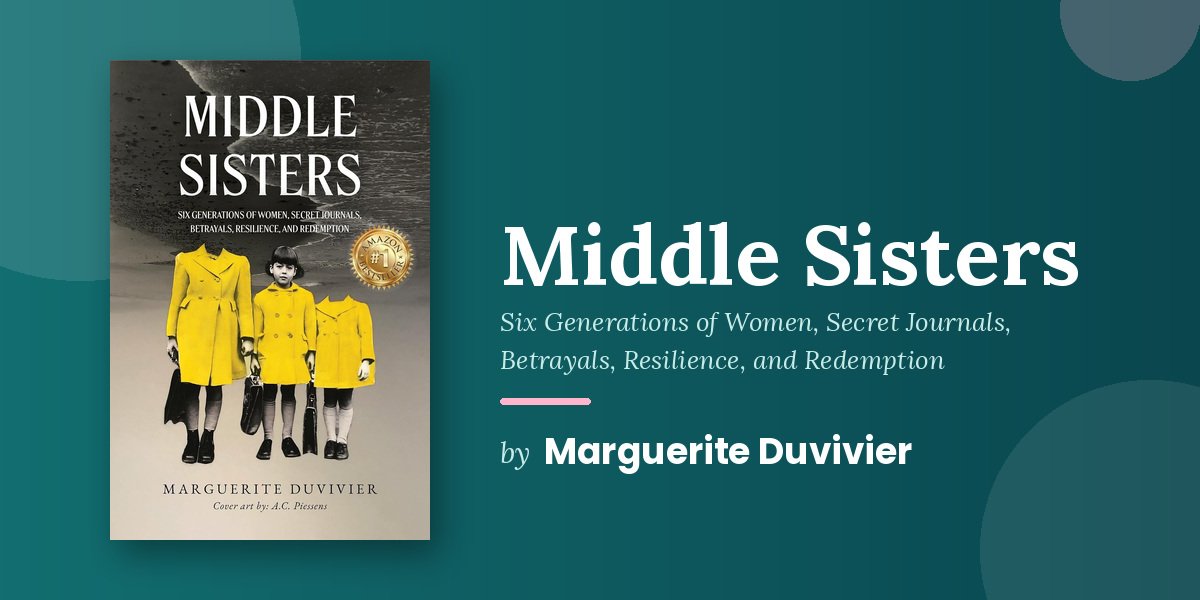
The multigenerational family memoir has a specific and demanding structural challenge that most books in the genre address only partially: the challenge of maintaining genuine intimacy with individual women across a narrative span that encompasses generations and continents and historical upheavals so large that individual lives risk being swallowed by the forces surrounding them. Marguerite Duvivier, the pseudonymous Associate Professor in Anatomic Pathology who wrote Middle Sisters, addresses that challenge through the device that makes the book genuinely distinctive: the secretly kept journals of Zilda, her mother, discovered after Zilda’s death and providing an interior record of a life that Duvivier witnessed partly from the outside and is now reading, with the specific disorientation of adult retrospection, from the inside.
The journey that Middle Sisters traces begins in Belgium in 1908 with a dominant mother coercing her vulnerable middle daughter into a loveless marriage, and it unfolds through two world wars, emigration to America, the specific economics of poverty followed by sudden affluence, infidelity, illness, tragedy, and betrayal, arriving in the present with a young mother’s determination to free her own family from the chains of past mistakes. That arc, from coercion to self-determination, from the powerlessness of Zilda’s arranged marriage to Marguerite’s fiercely independent spirit, is the memoir’s organizing momentum, and Duvivier traces it with the patience and the precision of someone who has spent a career understanding how the past continues to operate in the present.
The middle daughter figure who recurs across generations, overlooked during her formative years and leaned upon in old age, is the book’s most quietly devastating pattern. The favoritism and the jealousy that Duvivier documents without sentimentality, the specific experience of being the one who was not the favorite and who became the one who was needed, gives the book its emotional spine and its most durable human insight. Despite favoring Marguerite’s sisters during their formative years, it is Marguerite that Zilda leans on during her later years, a reversal that the memoir treats with the complexity it deserves rather than the satisfaction of simple poetic justice.
Duvivier weaves themes of money, infidelity, favoritism, jealousy, and self-determination against the backdrop of significant historical events, and she manages that weaving with the skill of someone who understands that historical context matters most when it illuminates rather than overwhelms the human lives it surrounds. Two world wars are present in Middle Sisters not as occasions for historical description but as forces that shape specific choices and specific losses in specific women’s lives, which is the only way historical context genuinely serves a family memoir.
If you love multigenerational memoirs that trace the patterns of women’s lives across the full sweep of history without losing sight of the specific and irreducible individuals at their center, Middle Sisters by Marguerite Duvivier is exactly the book that does both. Pick up your copy on Amazon today and meet the middle daughters whose secret journals finally allow their full stories to be told.