

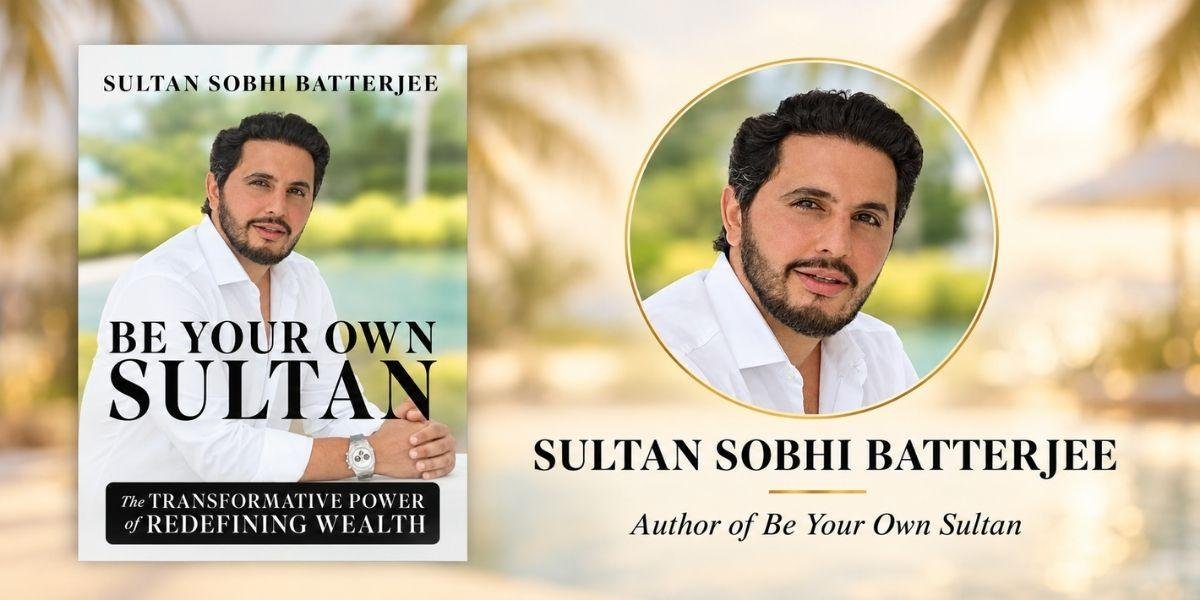
Sultan Sobhi Batterjee grew up inside a business legacy that stretches back more than a century. The Batterjee family has been active in Saudi Arabia since the 1920s, with a name connected to hospitals, medical colleges, real estate, business, and philanthropy.
That kind of inheritance can open doors.
It can also quietly create a scoreboard.
Sultan understands both sides because much of his own early definition of wealth was shaped by a sense of responsibility to build, achieve, and honor the people who came before him.
Today, as a father, he wants his children to inherit something slightly different.
He wants them to understand that the Batterjee name is an honor, not a measure of whether their lives are worthy.
That distinction sits at the heart of Be Your Own Sultan: The Transformative Power of Redefining Wealth.
The Afternoon That Mattered More Than an Award
One of Sultan’s clearest examples has nothing to do with a boardroom.
He remembers taking his children out on Jet Skis at their place on the Red Sea. He was teaching them tricks he had learned as a boy when they started asking him how he was doing them.
For Sultan, the moment stayed with him because it felt richer than the industry recognition he had collected throughout his career.
There was no audience.
No award.
No professional consequence.
Just his children, his attention, and an afternoon that would have been easy to miss if work had been treated as automatically more important.
That is exactly the kind of asset Sultan says he learned to recognize too late.
Family Time Is Not the Reward After Success
One of the beliefs Sultan now challenges is the idea that meaningful time with the people you love is something you earn after the important work is done.
That logic sounds reasonable until you consider that important work is almost never done.
There is always another deal, deadline, expansion, problem, or opportunity available.
If family receives only the time business does not consume, family may receive very little.
Sultan now treats those moments with the same intentionality he would apply to a critical client or major project.
That does not make every day perfectly balanced.
It means the allocation is deliberate.
His children have watched him build his own Wealth Pie and make choices out loud, including days when they come before the office.
Sultan believes those decisions may teach more about wealth than any lecture about money.
Legacy Is More Than What You Leave Behind
Sultan’s thinking about legacy also extends beyond family.
Through Greener, he has tried to apply his philosophy of wealth to environmental responsibility. For him, true wealth includes what is passed on to future generations, including the physical world they inherit.
That has practical implications in construction and real estate.
Resource efficiency and energy performance should not be treated as decorative compliance measures added at the end of a project. Sultan sees them as part of the responsibility owed to the people who will use those buildings and to the communities that remain after the project is finished.
When he thinks about his own eighty-fifth birthday, environmental impact is part of the picture.
He wants to be able to say that the technologies and practices he supported left communities better off, not simply better developed.
The Question Saudi Arabia Is Also Asking
Sultan’s message arrives during a period of extraordinary change in Saudi Arabia.
As Vision 2030 reshapes industries, entertainment, opportunity, and expectations, a younger generation is being offered possibilities that did not exist in the same form before.
Sultan sees a parallel between that national transformation and the personal question behind his book.
When more becomes possible, what should prosperity actually mean?
For generations, the familiar bargain has been straightforward: work hard, become successful, and happiness will follow.
Sultan no longer trusts that sequence.
He hopes younger Saudis can begin with a broader definition of wealth rather than discovering decades later that achievement alone did not provide everything they expected from it.
What Do You Want Them to Remember?
Sultan often returns to the image of the eighty-fifth birthday because it removes much of the noise surrounding status.
At that age, the questions become different.
Who is around you?
What did you build that mattered?
Did your children know you?
Did you protect your health?
Did your friendships survive?
Did the communities you touched become stronger?
Were you actually present for your own life?
For Sultan, those are not sentimental questions separate from wealth.
They are the definition of it.
That may be the lesson he most wants his children to inherit: the family name matters, but the life lived under that name matters more.
For readers who want to build a legacy measured by more than achievement, Be Your Own Sultan by Sultan Sobhi Batterjee is available now on Amazon.