

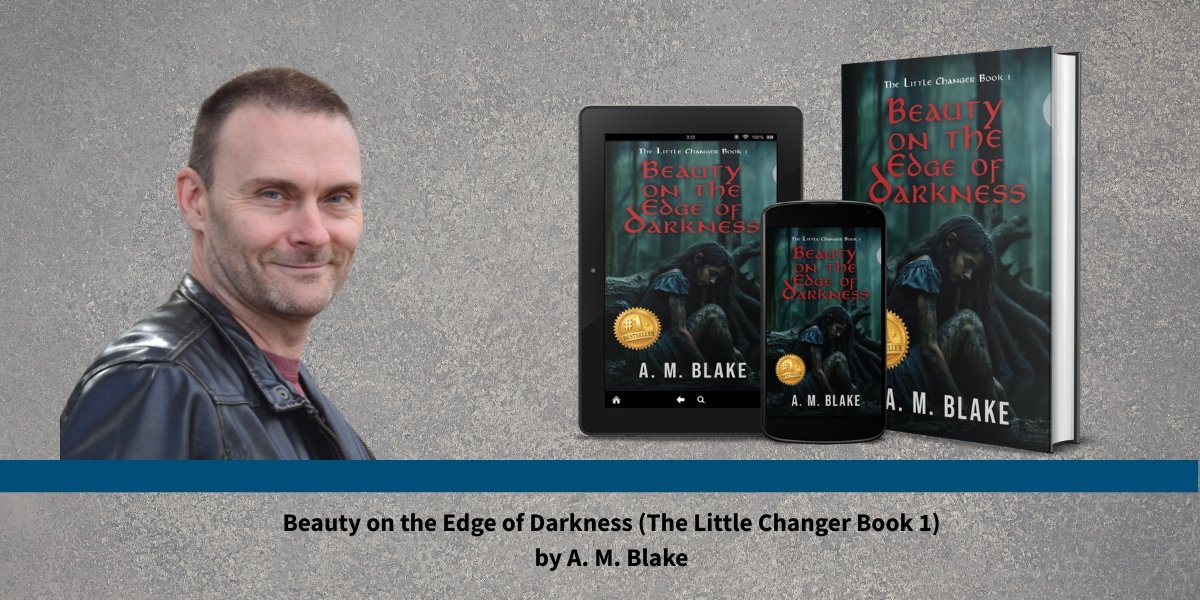
Some books start with research. Others start with imagination. But for A. M. Blake, this one started on the road.
Long hours as a truck driver tend to do something to your mind. You think differently. You sit with ideas longer than most people ever get the chance to. And somewhere in that quiet, repetitive space, a strange question showed up.
If myths like werewolves and shapeshifters exist across cultures, why is there no physical evidence?
That question didn’t go away. It pulled A. M. Blake into folklore, then into Cajun legends, and eventually into something far heavier: real history.
The Moment the Story Found Its Backbone
The Cajun rougarou legend was the spark. But the deeper A. M. Blake went, the more the story shifted.
Behind the myth was a real people with a real past. The Cajuns, descendants of the Acadians, carried a history marked by displacement, survival, and loss. That trail led straight into the French and Indian War, the fall of Quebec, and ultimately the expulsion of the Acadians.
And at that point, this was no longer just a dark fantasy idea.
A. M. Blake found something that fiction alone could not create. A backdrop filled with struggle, resilience, and human cost. The kind of history that does not need exaggeration to feel dramatic.
That became the foundation for Beauty on the Edge of Darkness.
A Character Built From Pressure, Not Comfort
At the center of the story is Jeanette Dubois. She is not just dealing with one transformation. She is dealing with several, all at once.
Physically, she is changing into something she cannot control. Emotionally, she is losing the safety of childhood. Spiritually, she is questioning where she belongs in a world that keeps pushing her out.
A. M. Blake did not design her to be heroic in the traditional sense.
Jeanette is meant to feel real. Someone caught in forces bigger than herself, trying to hold onto something steady while everything else shifts.
Her journey is not about becoming powerful. It is about not losing herself, and that distinction matters. The story is less about what she becomes and more about what she refuses to let go of.
The Weight of Being “Other”
One of the most striking layers in the book is how often Jeanette does not fit.
Her background already sets her apart. French Canadian and First Nation. Catholic in a changing religious landscape. A young woman coming of age in a world that does not make space for complexity.
Then the transformation begins, and suddenly, every difference becomes amplified. She is labeled. Feared. Rejected.
A. M. Blake leans into that discomfort instead of softening it. The idea of “otherness” is not symbolic here. It is constant and follows her in every interaction.
What makes it work is that it never feels exaggerated. It feels familiar. Everyone understands, at some level, what it means to feel like they do not belong, and Jeanette’s experience just pushes that feeling to an extreme.
Balancing Darkness Without Losing the Reader
Blending historical fiction with horror and fantasy sounds exciting. In practice, it is tricky. A. M. Blake ran into that quickly.
The subject matter alone can pull a story into a downward spiral. War, displacement, transformation, rejection. It is easy to stay in that space too long, but real life does not work like that.
Even in the middle of chaos, there are moments of relief. Small pockets of connection. Brief flashes of something lighter.
A. M. Blake made a deliberate choice to include those moments, not to soften the story but to make the darker parts hit harder.
Without contrast, everything feels the same. With it, the emotional weight becomes sharper.
The Research That Almost Took Over
There is another challenge that does not get talked about enough: too much history.
A. M. Blake found so much material that the first draft ended up far longer than the final version. Entire scenes, characters, and historical details had to be cut, not because they were bad but because they slowed the story down.
That is a hard decision for any writer, especially when the material is genuinely interesting. But A. M. Blake made a clear distinction: history is the canvas, not the story itself.
The goal was not to recreate events perfectly. It was to build something new inside that world. Something that carries emotional truth, even if the details are fictional.
Transformation That Feels Personal
At its core, Jeanette’s transformation is not solely physical.
It is a coming-of-age story, but stripped of comfort. There is no gentle transition, no clear guidance, no safe space to figure things out. Everything happens under pressure,
and that is where the story connects.
Growing up rarely feels smooth. It is confusing. Painful. Unpredictable. A. M. Blake pushes that idea further by tying it to identity. What happens when you are changing in ways you do not understand, while also being told you do not belong?
Jeanette’s answer is not perfect, but it is consistent. She keeps trying to hold onto her humanity, even when everything around her is trying to take it away.
Why This Story Stays With You
There are a lot of dark fantasy stories out there, but what makes this one different is where it places its focus. It is not about spectacle nor shock value. It is about endurance.
A. M. Blake built a story in which beauty and darkness exist at the same time. In which loss and love sit side by side. In which identity is not fixed, but constantly tested. And in which the real question is not what you become but whether you can still recognize yourself when everything changes.
That is what gives Beauty on the Edge of Darkness its edge. Not just the horror or the history, but the feeling that, underneath it all, this is still a very human story.
You can find Beauty on the Edge of Darkness on Amazon and dive into a story filled with history, transformation, and raw human resilience.