

By: Andrea Rocchino
The One Thing He Wishes Someone Had Told Him
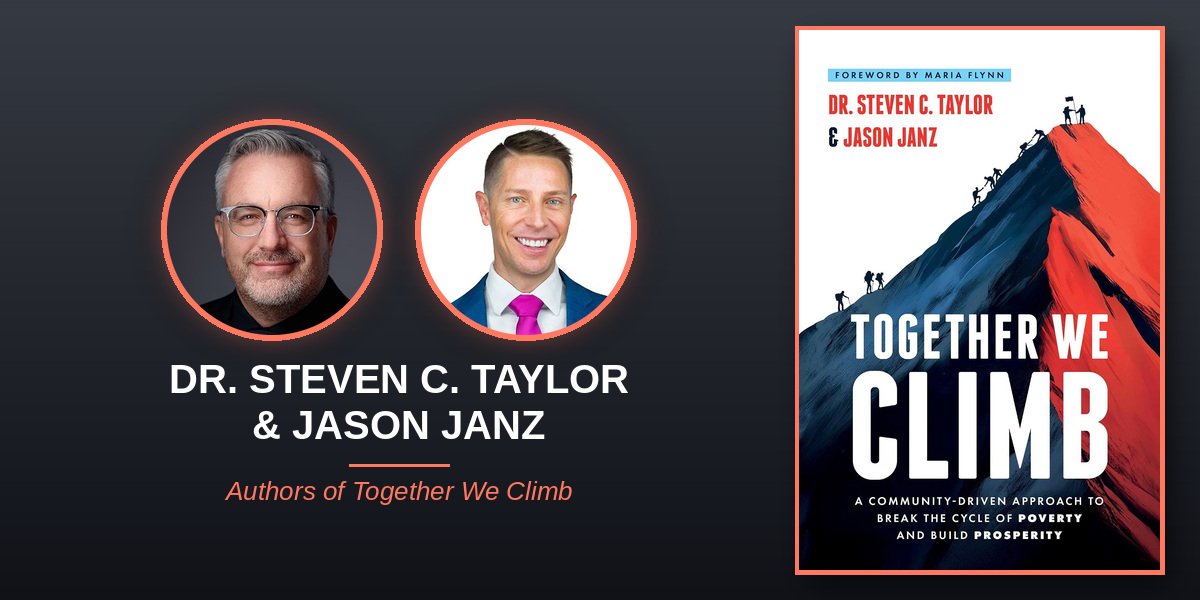
Jason Janz grew up at the bottom of the mountain. He knows what it feels like to look up at a climb that seems designed to defeat you before you start, to have fewer resources than the people around you, less access, less margin for error, and less of the relational network that most people take for granted as background infrastructure. If he could go back and tell his younger self one thing, it would be this: the key to moving up was surrounding himself with people who had already been there. Not programs. Not credentials. People. The relationships you build shape your thinking, create access to opportunities you would not otherwise know exist, and hold you up when the climb gets discouraging enough to make you want to stop. That insight became the organizing principle of CrossPurpose, the organization Jason now leads in Denver, and it is one of the central arguments in Together We Climb, the book he co-wrote with Steven C. Taylor and Maria Flynn.
What CrossPurpose Got Wrong Before It Got It Right
CrossPurpose did not start with the model it has today. Jason is direct about what the organization got wrong before it learned better. It began as a nicher: a job training program focused on one piece of the problem. That approach worked until it didn’t, which happened the moment a student lost housing mid-course or had childcare fall through. At that point the training became irrelevant, and CrossPurpose had to become something different. What it became is what Jason calls the family doctor of poverty, a navigator connected to more than two hundred partner organizations that knows the whole person and stays with them across the full journey, not just the employable parts of it. The organization also had to unlearn the assumption that hard skills were the core challenge. Calvin was a strong student who landed a job and then disappeared. When his story finally came out, the team learned that every thunderstorm in Denver sent his nervous system back to a traumatic childhood experience. His inconsistency at work was not about work ethic. It was about unhealed wounds that no job training had addressed, and no job would fix.
Owning the Pond
Jason heard the fish proverb for a decade. Give a man a fish, feed him for a day. Teach a man to fish, feed him for a lifetime. It was not wrong, but it stopped too early. His version finishes it: equip him with a good pole, and help him own the pond so his children never have to fish for survival. That extension is not rhetorical. It reflects a precise diagnosis of where most anti-poverty work stops short. CrossPurpose’s Own the Pond program and Legacy Fellowship exist because a conversation with Julie Stone at Gary Community Ventures forced Jason to confront the data: CrossPurpose graduates were doing better, earning more, but they were still paycheck to paycheck. Just at a higher altitude. Without savings, without assets, without anything to pass to the next generation, the gains of one generation do not change the starting point of the next. That is the difference between helping a family get by and breaking the cycle of generational poverty for good.
Expensive Love
Tiffany finished CrossPurpose’s program and started a new job. Her husband came home. Her second daughter Maya was born. Life finally felt like it was coming together. Then Maya went into cardiac arrest, was declared brain-dead, and her husband fell apart and went back to jail. Tiffany was supposed to start her new job in three days with a child on life support. Her thought was that this is what happens when you try to climb. This is why you do not take steps. That is the moment a community either shows up or doesn’t. Her ally Rachel and Jason’s wife Jen Janz said they would take shifts. For four months they sat in on every hospital meeting Tiffany could not attend. Jason calls that expensive love. It costs something. It shows up when it is inconvenient. Today Maya walks, talks, and argues with her sister. Economic capital gets you a job. Relational capital keeps you from facing life alone. Spiritual capital gives you the strength to rise again after you fall.
What Jason Asks of Employers
Jason does not ask employers to treat CrossPurpose graduates as charity hires. He asks them to treat graduates as people who can stand toe to toe with the market and contribute to the bottom line, because they can. What he asks in addition is that employers think differently about the people they are screening out before a human sees their name: the twenty-seven million hidden workers who are parents, caregivers, people with records, people without degrees. He asks employers to hire for virtue first and skill second, because skills can be taught and character is harder to develop after the fact. He asks them to look at their benefits packages as wealth-building tools rather than overhead. Dan Schulman at PayPal discovered that junior employees had four to six percent of their income left after basic expenses. Some were selling plasma. The turnover costs that generates, Jason points out, could be redirected into emergency loan programs and matching contributions that would build genuine loyalty and genuine financial stability. The most powerful anti-poverty program ever invented is a good job inside a value-creating business. Employers are the heroes of this economy. Together We Climb means that.
The Research Behind the Relationships
Raj Chetty’s research on twenty-one billion Facebook friendships found that cross-class connection is the single strongest predictor of upward economic mobility we know of. If low-income kids grew up with the same cross-class friendships as high-income kids, their adult incomes would rise about twenty percent. That is not a soft finding about the value of community. It is a hard finding about the structural role that relationships play in determining outcomes. CrossPurpose has built its entire program design around that reality. The first day of class is about getting to know each other. Every participant receives a weekly career coach and a dedicated volunteer ally. There is a sign on the wall at every site: there is no significant change without a significant relationship. Together We Climb is the argument for why that sign belongs at the center of every serious anti-poverty effort in the country.
Pick up your copy of Together We Climb by Steven C. Taylor and Jason Janz, with Foreword by Maria Flynn on Amazon today.