
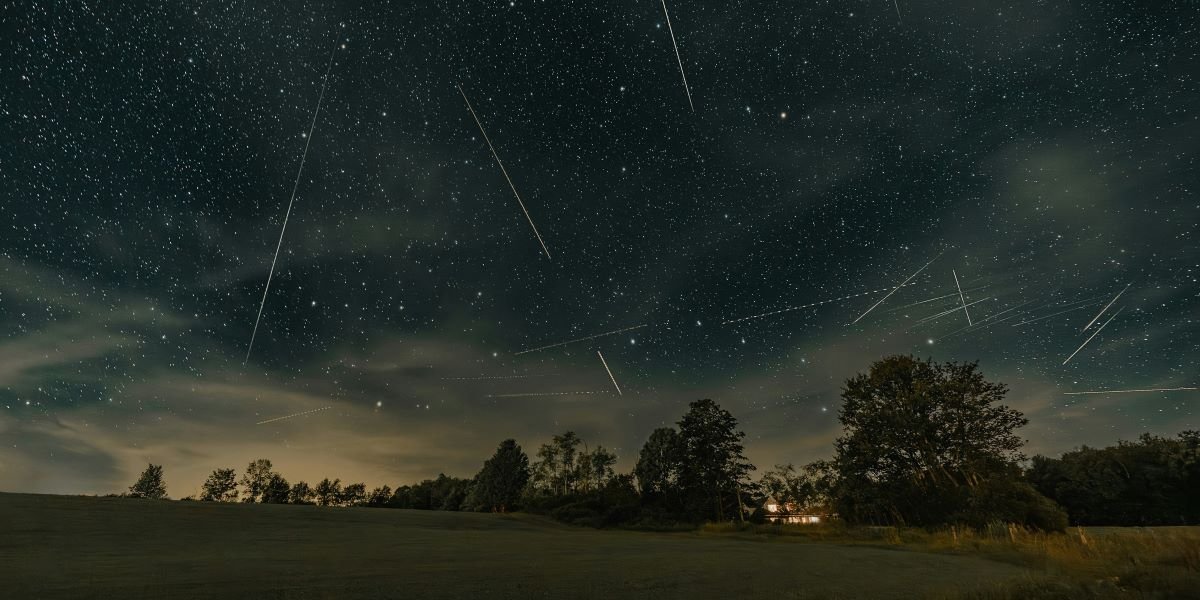
The Geminid meteor shower peaks on the night of December 13 to 14, 2026, under a thin crescent moon. Spain’s National Astronomical Observatory centers the maximum at 14:00 UT on December 14. That puts the exact peak in darkness for East Asia, while a broad window still gives the Americas and Europe a strong night of viewing.
Key Takeaways
- The International Meteor Organization lists the Geminids as active December 4 to 17, 2026, with peak night December 13 to 14.
- Spain’s National Astronomical Observatory centers the 2026 maximum at 14:00 UT on December 14, with a broad peak of about 12 hours.
- The moon is a waxing crescent about 15% lit on peak night, according to the International Meteor Organization.
- The International Meteor Organization’s 2026 calendar lists a zenithal hourly rate of up to 150 meteors per hour under ideal skies.
- The Geminids are the one major shower with good activity before midnight, as Gemini is well placed from 10 p.m. local time.
- Southern Hemisphere viewers can see the shower, but only in the middle of the night and at reduced rates.
The 14:00 UT Maximum Explains Why Guides Disagree on the Best Night
The Geminid meteor shower does not peak at the same local hour everywhere. Its maximum is tied to a single moment on Earth’s orbit, which Spain’s National Astronomical Observatory places at 14:00 Universal Time on December 14, with a broad peak lasting around 12 hours. Observing guides citing the International Meteor Organization describe enhanced activity from about 21:00 UT on December 13 through 18:00 UT on December 14.
A 14:00 UT peak falls during daylight in the Americas and Europe and in darkness across East Asia. A single “best night” therefore does not apply to every reader. The broad window is what keeps the shower strong across several regions at once, and it is why both the night of December 13 to 14 and the night of December 14 to 15 appear in viewing advice.
The Best Night Depends on Where Viewers Are
The Americas Get Their Best Look on the Night of December 13 to 14
For North and South America, the entire night of December 13 to 14 sits inside the enhanced window. The 14:00 UT maximum falls at 9 a.m. in New York, 6 a.m. in Los Angeles, and 11 a.m. in São Paulo, so the hours before dawn on December 14 come closest to the peak.
Europe and Africa Have Two Workable Nights
In Europe, the enhanced window opens at 21:00 UT on December 13, which is 10 p.m. in Paris, and covers that whole night. The maximum itself lands at 2 p.m. in London and 3 p.m. in Paris on December 14. Activity remains elevated into the early evening of December 14 before the window closes at 18:00 UT. Some guides recommend the night of December 14 to 15 for Europe, but the earlier night sits more fully inside the strongest activity.
South and West Asia Catch Both Ends of the Window
The maximum falls at 6 p.m. in Dubai and 7:30 p.m. in Delhi on December 14. The predawn hours of December 14 and the evening that follows both fall inside the enhanced window. Rates improve as Gemini climbs higher after 10 p.m.
East Asia and the Western Pacific See the Peak in Darkness
East Asia is best placed for the exact maximum. The 14:00 UT peak arrives at 10 p.m. in Manila and Beijing and 11 p.m. in Tokyo and Seoul on December 14. That matches the hours when the International Meteor Organization says Gemini is well placed. Viewers there should plan for the night of December 14 to 15.
Australia and the Southern Hemisphere Watch Later, at Lower Rates
In Sydney, the maximum falls at 1 a.m. on December 15. The International Meteor Organization notes that the Geminids are visible from the Southern Hemisphere only during the middle of the night and at a reduced rate, because the radiant sits lower in southern skies. Readers following other polar-sky science this season can compare this year’s Antarctic ozone hole measurements, which tracked how the atmosphere over the far south behaved this spring.
A Thin Crescent Moon Keeps the Sky Dark
The 2026 Geminid meteor shower benefits from timing on the lunar calendar. The International Meteor Organization lists the moon at about 15% illumination, a waxing crescent, on peak night. It sets in the early evening and leaves the darkest hours free of moonlight.
The other showers of the season do not get that advantage. The International Meteor Organization lists the moon at 89% illumination for the Ursids on December 21 to 22. The Quadrantids follow on January 3 to 4, 2027, with a predicted peak near 3:30 UT on January 4 that favors Europe and western Asia.
Asteroid Phaethon Shapes How the Geminids Look
The Geminid meteor shower comes from debris left by asteroid 3200 Phaethon, a rocky parent body rather than the icy comets behind most major showers. The International Meteor Organization describes Geminids as often bright and intensely colored. Their medium-slow speed means persistent glowing trails are uncommon.
The peak arrives the same week as the December 10 Nobel ceremonies in Stockholm. This year’s physics prize went to the physicist who turned Antarctic ice into a neutrino telescope, which gives astronomy readers two December events to follow.
Practical Viewing Tips
The International Meteor Organization’s figure of up to 150 meteors per hour assumes ideal dark skies with the radiant overhead. Real counts are lower for most observers, and lower still in brightly lit cities. Getting away from streetlights makes the largest difference.
That advice matters most in places where nighttime activity keeps streets lit late, from how nighttime culture compares from Lagos to Seoul and Sydney to smaller urban centers. Viewers should give their eyes about 20 minutes to adjust to the dark.
Not every streak seen on peak night is a Geminid. Some are random sporadic meteors, and others belong to weaker showers such as the Monocerotids and Comae Berenicids.
FAQs
When does the Geminid meteor shower peak in 2026?
The Geminids peak on the night of December 13 to 14, 2026, according to the International Meteor Organization. The shower is active from December 4 to 17.
What time is the Geminid maximum in 2026?
Spain’s National Astronomical Observatory centers the maximum at 14:00 UT on December 14, with a broad peak of about 12 hours. That is 9 a.m. in New York, 2 p.m. in London, and 11 p.m. in Tokyo.
Will the moon interfere with the 2026 Geminids?
Very little. The moon is a waxing crescent about 15% lit on peak night and sets in the early evening, leaving dark skies for most of the night.
Can the Geminids be seen from the Southern Hemisphere?
Yes, but only in the middle of the night and at reduced rates, because the radiant sits lower in southern skies.
How many Geminid meteors can viewers expect per hour?
The International Meteor Organization’s 2026 calendar lists a zenithal hourly rate of up to 150 under ideal dark skies. Most observers will see fewer, especially near city lights.