

Drivers in the United States killed 6,732 people who were walking in 2025, according to the Governors Highway Safety Association’s preliminary state-by-state pedestrian fatality data. That is about 18 deaths a day. The total fell 7% from the year before, yet it still sits above the level recorded before the pandemic. Some of those crashes happen at ordinary intersections where nobody ever painted a line, and where both people involved may have had the wrong idea about the unmarked crosswalk in front of them.
The driver often assumes that no stripes means no crosswalk. The pedestrian often assumes that being in a crosswalk means being protected regardless of anything else. George Mkrtchyan, Esq., Managing Attorney of Court House Lawyers in Glendale, California, argues that both assumptions can fail at the same corner. In his view, an unmarked crosswalk at an intersection can be a crosswalk in the full legal sense, and the evidence that shows what really happened there tends to disappear faster than anyone expects.
An Unmarked Crosswalk Is Still a Crosswalk
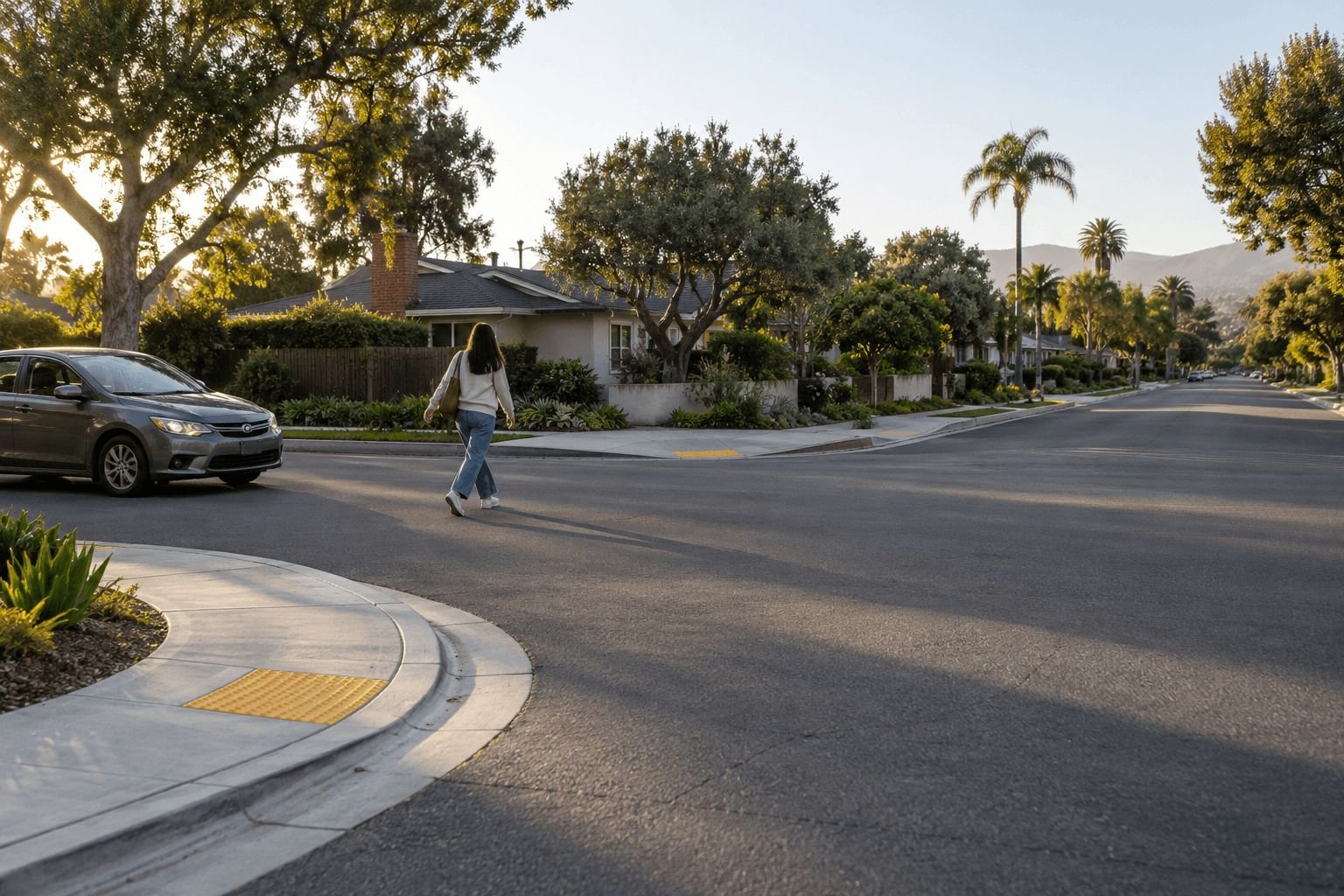
Traffic rules vary from state to state, so the details depend on where a crash happens. California offers a clear worked example. Under Vehicle Code § 275, a crosswalk includes the part of the roadway formed by extending the sidewalk boundary lines across an intersection. Paint is not what creates it. The intersection does.
That definition has a limit. In California, an unmarked crosswalk generally exists only at an intersection. A pedestrian who crosses in the middle of a long block is not in an unmarked crosswalk, even if the spot feels like a natural place to cross.
“People tend to think the paint decides who was right,” Mkrtchyan says. “It often doesn’t. The intersection itself can create the crosswalk, and both people still have a duty to be careful.”
What Drivers Often Get Wrong
California’s core rule sits in Vehicle Code § 21950. It requires drivers to yield the right of way to pedestrians crossing within a marked crosswalk or within an unmarked crosswalk at an intersection. The same section also places a continuing duty of due care on drivers approaching a pedestrian.
That continuing duty is the part drivers tend to forget. A green light or a clear lane does not end it. A driver turning through a quiet residential corner may never register that a crosswalk exists there, because nothing on the pavement says so. Under California’s rule, that may make no difference. The question can turn on where the pedestrian was and whether the driver used reasonable care.
What Pedestrians Often Get Wrong
The right of way is not unconditional. The same statute also says a pedestrian may not suddenly leave a curb or other place of safety and walk or run into the path of a vehicle so close that it creates an immediate hazard. Pedestrians are expected to use reasonable care too.
California loosened one rule in recent years. The Freedom to Walk Act, Vehicle Code § 21955, took effect January 1, 2023, and decriminalized crossing outside a crosswalk when it can be done reasonably safely. A crossing that no longer brings a ticket can still raise questions about fault in a civil claim, though, which is why the details of the crossing, and the proof of them, often carry so much weight.
The Evidence Fades Faster Than the Paint
Unmarked crosswalk cases often come down to a few seconds and a few feet. Where was the pedestrian standing? How fast was the car moving? Did the driver look? The answers usually sit on camera footage that belongs to someone else.
“Surveillance video is often some of the most useful evidence at a crossing, and it may not be kept for long,” Mkrtchyan explains. “If you can, ask to see the video, record it on your phone, and send a preservation letter quickly.”
Pedestrian cases at Court House Lawyers generally begin with preservation letters for traffic cameras, business surveillance, rideshare dashcam footage and 911 audio, because that material is often deleted within days. When the driver leaves the scene, uninsured motorist coverage on the pedestrian’s own auto policy can sometimes apply.
Timing counts in a second way. The general deadline to file a personal injury lawsuit in California is 2 years under Code of Civil Procedure § 335.1. When a public entity is involved, such as a city responsible for an intersection, a government claim generally has to be filed within 6 months under Government Code § 911.2.
Where the Lines Are Missing
Mkrtchyan previously practiced at a larger Century City personal injury firm before founding his own practice in Glendale in August 2022. His view of pedestrian cases is practical rather than dramatic. The legal question at an unmarked corner is often simpler than people think. The proof is usually the hard part.
For drivers, the lesson is that a corner without stripes may still be a crosswalk. For pedestrians, it is that the right of way comes with a duty of care. For both, it is that the record of what happened can start disappearing almost as soon as the crash is over.
The national numbers are moving in the right direction. Many unmarked corners look exactly the same as they did before: no paint, no signal, and two people who each believed the other was supposed to stop.
Disclaimer: The content in this article is provided for general knowledge. It does not constitute legal advice, and readers should seek advice from qualified legal professionals regarding particular cases or situations.