

When an owner asks whether fast money is worth it, the honest reply is: compared with what, and for what? A next-day loan that captures a profitable order can be a bargain at a high price. The same loan used to cover a recurring shortfall can make next quarter worse.
So let’s put the decision on a scale. Five issues follow, each with a pros column and a cons column, and each ends by tipping one way. Funding in about 24 hours is possible for some qualified applicants, but it depends on the lender, the file, and the banking calendar, and nobody can responsibly promise it in advance.
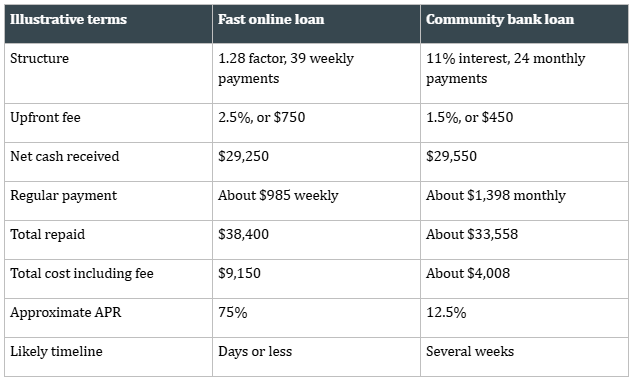
To keep the weights honest, we’ll use one illustrative example throughout. Fernwood Catering, a fictional company, needs $30,000 and has two hypothetical choices.
Issue 1: Price
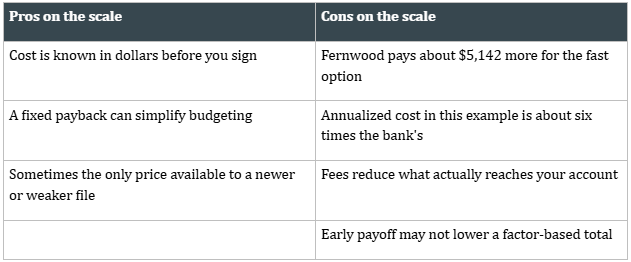
Which way it tips: Toward cons. Speed is almost always something you pay for, so the only real question is whether you’ll earn back that $5,142.
Before accepting a quote, it’s useful to read neutral explainers about APR, factor rates, and fees. Articles like those in Fundivi resources for fast-funding research can give you the vocabulary to question an offer.
Issue 2: Timing and Opportunity
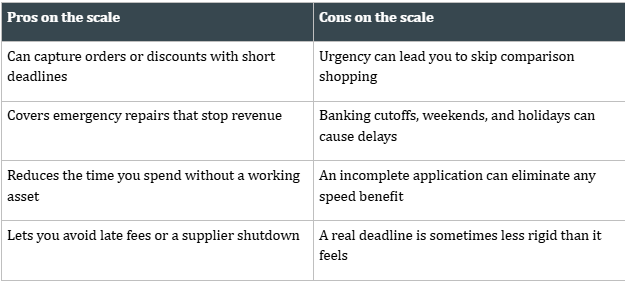
Before you trust a deadline, call the person who set it. Suppliers and landlords will sometimes grant a week if you ask early, and a week may be enough to get a cheaper quote.
Which way it tips: Toward pros, if the deadline is genuine. Suppose Fernwood has a wedding-season contract that generates $14,000 in gross profit, and a deposit is due in three days. The fast loan costs $9,150, leaving $4,850 from an order the bank’s timeline would have missed. Now change the facts: if the same money only pays last month’s bills, there’s no $14,000 on the other side of the scale.
Issue 3: Cash Flow Pressure
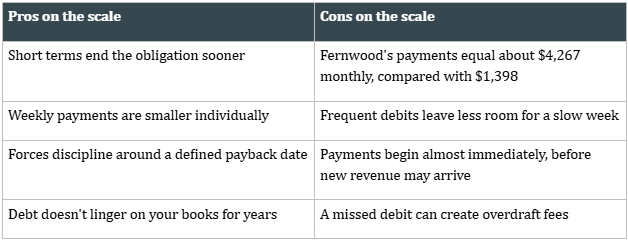
Which way it tips: Strongly toward cons for seasonal or thin-margin businesses. Compare the payment with your weakest month instead of your average. If Fernwood’s slow months produce $5,000 in free cash, a $4,267 payment leaves very little for anything that goes wrong. A catering company can’t reschedule a broken van or a canceled event, so a thin cushion becomes a serious operating risk.
Comparison sites can help you see what’s available at different repayment speeds. BusinessLoansEngine.com 24-hour loan comparisons is one place to learn about and compare options, but rely on the written offer for actual terms.
Issue 4: Access and Paperwork
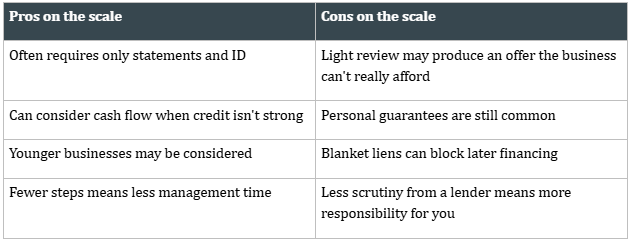
Which way it tips: Toward pros on access, though with a warning. Being approved is not the same as being able to afford it. A bank’s slower process does some of your risk analysis for you, and with a fast product you have to do that work yourself. Build your own short forecast covering the entire repayment period before accepting. Unsecured doesn’t mean consequence-free; a look at unsecured online business loans can help illustrate this when you check how those products handle promises and security.
Issue 5: What Happens Afterward
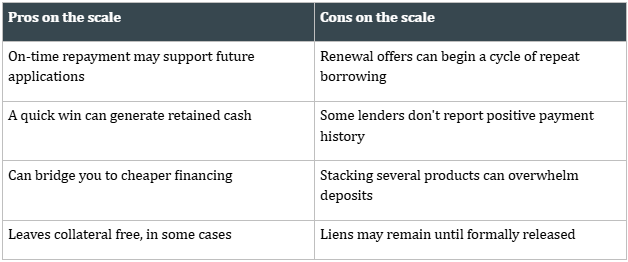
Which way it tips: Evenly balanced, and it depends on your exit. Merchants whose revenue comes mainly from cards might also weigh another structure when thinking about what comes next. A Barchart press release on card processing loans describes a launch in that category, where repayment is tied to card activity. As with any fast option, get the total dollars in writing before comparing it with a fixed-payment loan. Also ask whether a renewal will be offered partway through, and decide in advance that you’ll judge it as a separate borrowing decision.
Reading the Final Scale

Now apply a short test. A fast loan is more likely to be worth it when you can answer yes to all four:
- The deadline is real and costs a measurable amount if you miss it.
- The money directly produces revenue or prevents a larger loss.
- The payment fits inside your weakest recent month.
- You’ve identified where repayment comes from, without borrowing again.
It’s more likely to be a mistake if the loan is solving a problem that will be back next month, if you’ve got another advance outstanding, or if the main thing recommending it is that a salesperson called today.
The Verdict
Fast business loans can be worth it, but only as a tool for specific, profitable, time-sensitive moments. In Fernwood’s example, the extra $5,142 was justified by a $14,000 contract and not justified by ordinary overhead. On the whole, the scale tips against speed as a default and in favor of speed as an exception.
The best preparation may be to reduce the need. Keep statements ready, and open a line of credit while your business is healthy, so that the next emergency doesn’t leave one expensive choice. A line you don’t use often costs little or nothing to keep, depending on its fees, and it gives you a real alternative when a fast offer appears. Even a modest reserve can change the math, since every dollar you already hold is a dollar you won’t have to buy at a premium.
Frequently Asked Questions
Are 24-hour loans a scam?
Not inherently. Be cautious of anyone who promises approval without reviewing your information or asks for upfront payments before funding.
What’s needed to apply?
Commonly, recent bank statements, identification, business details, and a list of existing debts. Requirements vary between lenders.
Can weekends delay funding?
Yes. Banks and transfer networks follow schedules, so applications late in the week may not settle until the following business day or later.
Will a fast loan help my credit?
Only if the lender reports payments to business credit bureaus. Ask before assuming it will.
Is a factor rate the same as an interest rate?
No. A factor rate is a multiplier on the amount funded, and its annualized equivalent is usually much higher than the number suggests.
How can I compare a fast offer to a bank loan?
Compare net cash received, total repayment, payment timing, and estimated APR on the same page, as in the table above.
Disclaimer: This content is for general informational purposes only and should not be considered as financial advice. The content is not intended to be a substitute for professional financial advice, investment advice, or any other type of advice. You should seek the advice of a qualified financial advisor or other professional before making any financial decisions.