
There’s a comfortable assumption inside most large organizations. The assumption that institutional decision-making is somehow more rational than individual decision-making. That scale brings objectivity. That process brings clarity. That the collective is smarter than the individual.
Andres Kuusk has spent years advising financial institutions and credit bureaus on strategy and risk management. His assessment of that assumption is direct.
Organizations suffer from many of the same cognitive distortions as individuals. They just do it on a larger scale and with more serious consequences.
The Psychology of Organizations
Andres identifies the specific ways organizational psychology tends to fail. Companies become overconfident after stretches of success, developing a conviction that they understand their environment that far outpaces what the evidence actually supports. They become attached to existing assumptions, continuing to operate from premises that stopped being accurate years ago because nobody stopped to question them. They focus on short-term outcomes rather than decision quality, optimizing for what looks good in the next reporting period rather than what builds genuine long-term strength.
And they avoid uncomfortable information. The data that challenges the current strategy. The signals that suggest the plan isn’t working. The voices inside the organization that are seeing something the leadership isn’t ready to hear.
Organizations, in other words, have psychology. But unlike an individual’s thinking, organizational psychology becomes embedded in processes, incentives, reporting structures, and culture. Assumptions made years ago gradually become “the way we do things.” Eventually, people stop seeing them as assumptions at all. They simply become reality inside the organization. That is what makes organizational distortions so dangerous. The larger the organization, the more expensive an unquestioned assumption becomes.
How Assumptions Become Culture
One reason organizational mistakes are so difficult to recognize is that they rarely look like mistakes from inside the organization.
Every presentation appears logical.
Every meeting reinforces the same conclusions.
Every report seems to support the existing strategy.
Until reality eventually demonstrates that everyone has been analyzing the wrong problem.
Organizations almost never fail because people stop thinking. They fail because everyone continues thinking from the same unquestioned assumptions. The danger isn’t disagreement. The danger is unanimous agreement built on an incorrect premise.
The Agent Mulder Method at Scale
One of the ten rules Andres describes is what he calls the Agent Mulder Method. The idea is simple but remarkably powerful: assumptions should never be treated as permanent facts. They should be treated as hypotheses.
The process has three steps.
First, spot the assumptions quietly shaping a decision.
Second, challenge them by asking what evidence actually supports them, and what evidence might point in another direction.
Finally, test them whenever possible before committing major resources.
Many of the largest corporate failures did not begin with a disastrous decision. They began with an assumption that nobody thought to question: about the market, customer behavior, competitors, regulation, or even the organization’s own capabilities. By the time reality exposed the mistake, the assumption had already shaped months or years of decisions.
The organizations that remain curious, that keep asking whether their assumptions are still accurate, adapt faster than organizations that become convinced they already understand everything relevant. That curiosity isn’t a soft attribute. It’s a genuine competitive advantage, measurable in how quickly a company recognizes and responds to change.
Why the Rules Scale
The ten rules in Unlocking the Success Puzzle were developed from Andres’s observation of high-performing individuals across decades of competition and professional advisory work. What surprised him, as he refined the framework, was how consistently the same principles applied when he moved from individuals to teams to entire organizations.
Thinking in sequences is as critical for strategic planning as it is for personal decisions. The decision being made today matters not just for its immediate effect but for the future decisions it makes possible or impossible. Leaders who think only one move ahead are playing a different and less effective game than leaders who are thinking about the position they’re building toward three moves from now.
Decision quality evaluated separately from outcome quality matters at the organizational level too. Companies that judge their decisions entirely by how they turned out miss the entire point of decision analysis. Good decisions sometimes produce bad outcomes. Bad decisions sometimes produce good outcomes. Confusing the two leads to all the wrong lessons.
Organizations spend enormous resources improving execution. Far fewer spend the same energy questioning the assumptions behind what they are executing. Yet execution only amplifies the quality of the underlying thinking. If the assumptions are wrong, better execution simply gets the organization to the wrong destination faster.
That is why Andres believes one of the greatest competitive advantages is the ability to recognize when the way you are thinking no longer matches reality.
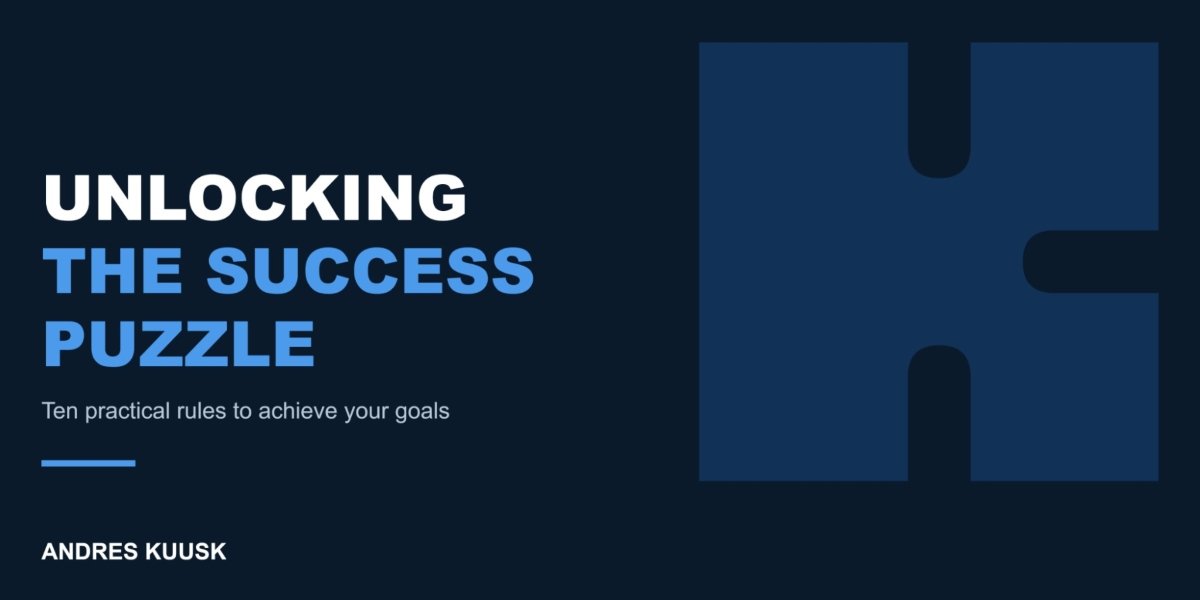
Unlocking the Success Puzzle by Andres Kuusk is available now on Amazon.