
In a picture book, the pictures are not a decoration for the story. They are half the story, and frequently the better half. A well-made picture book has text and image doing different jobs, which is why reading one aloud works: the adult supplies the words, and the child reads the pictures.
Authors commissioning children book illustration services for the first time usually underestimate both how long it takes and how much of the outcome depends on decisions made before anyone draws anything.
Stage One: The Brief and the Style
Style is chosen first, and it is chosen by showing rather than describing.
Adjectives do not transfer. “Warm,” “playful” and “modern” mean different things to everyone. What works is a reference set of ten to fifteen published books whose look is close to what you want, with a note on what specifically appeals in each: the line quality here, the colour palette there, the way this one handles faces.
The style decision should follow the age band. Younger readers respond to bold shapes, clear outlines and strong colour; older picture book readers can handle detail and visual subtlety. A style that is beautiful but too sophisticated for the age band is a common and expensive mismatch.
Medium matters too watercolour, digital, collage, gouache partly for the look and partly because digital work is easier to revise than traditional media.
Stage Two: Character Design
Before any page is illustrated, the main characters are designed and locked.
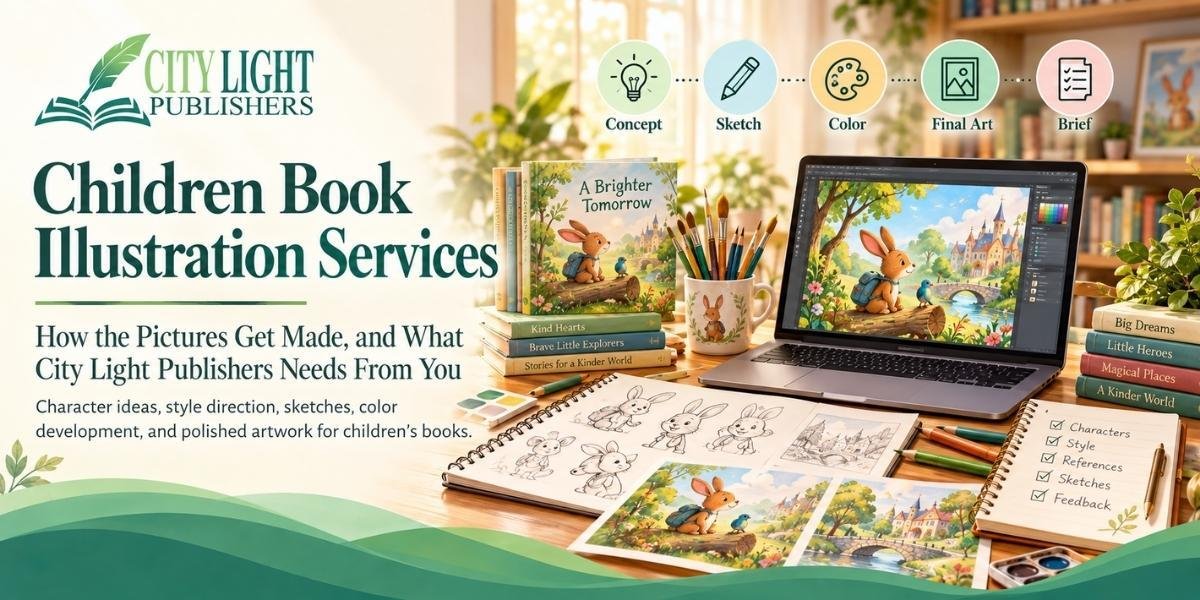
This produces a character sheet: the character from several angles, in several expressions, with proportions and colours fixed. It exists so that the character looks like the same character on page four and page twenty-six, which sounds obvious and is the most common consistency failure in unmanaged projects.
This is also the stage where the author’s input matters most and is easiest to give. A character who is nearly right is far cheaper to adjust now than after fourteen spreads have been painted.
Stage Three: The Storyboard
The text is divided across the book’s spreads for a standard 32-page picture book, roughly fourteen after front matter, and thumbnailed.
This is the structural stage, and it is where the manuscript is tested. A story that reads well as continuous text can fall apart here: three consecutive spreads with no visual change, a page turn that lands mid-sentence, a climax that has nowhere to go because the pages have run out.
Fixing these problems at the thumbnail stage is inexpensive. Fixing them at the finished-art stage is not. Authors should expect, and welcome text changes at this point: moving a line to the next spread, cutting a sentence the picture already carries, adding a page turn where the story needs suspense.
Stage Four: Sketches, Then Finals
Full-size rough sketches for every spread come next, showing composition, character placement, and the flow of the eye across the page. These are reviewed and revised.
Then final art, usually delivered in batches. Revisions at this stage should be small and specific: an expression, a background element, a colour adjustment. Structural changes here mean redoing work.
The discipline that keeps projects on schedule: approve properly at each gate. Approving a sketch you are unsure about, intending to raise it later, is how a project doubles in length.
The Text–Image Split, Which Is a Writing Problem
The most useful thing an author can do for an illustrator is take things out of the manuscript.
Anything the picture can show, the text should not say. Descriptions of what the character is wearing, what the weather is doing, what the room contains these are the illustrator’s territory, and text that occupies it flattens the book and leaves the artist nothing to contribute.
What the text should keep: dialogue, interiority, time passing, the turn of a joke, anything a picture cannot carry.
The best picture books put text and image in slight tension, the words saying one thing while the picture shows another. That tension is a joke, a reveal, or a piece of characterization, and it only becomes possible when the text leaves room.
Rights, Which Matter More Here Than Anywhere
Illustration is where children’s book rights get complicated, and it deserves attention before work begins.
Settle in writing: who owns the finished artwork; whether ownership covers the character designs themselves and not only the specific images; whether you can use the art in marketing, merchandise, or a sequel; whether the illustrator is credited on the cover, which is conventional; and whether you receive full-resolution working files.
Character ownership is the clause that matters for any book with series potential and children’s books that work almost always have series potential. City Light Publishers states that authors “retain 100% ownership, rights, and royalties” across its services; for illustrated work specifically, confirm that this extends to the artwork and the characters, and have the agreement reviewed.
Timeline and Production
Illustration is a long stage. Character design, storyboarding, sketches, and finals for a full picture book run months, not weeks, and the calendar should be built around that rather than around the writing.
Production then has its own demands. Colour interiors change print economics substantially, full-bleed artwork requires high image resolution, fixed-layout digital editions behave differently from reflowable text, and the cover must appeal to a buying adult and a choosing child at once.
City Light Publishers handles children’s book writing and editing as distinct services, alongside cover design, formatting, printing and distribution which matters because an illustrated book has more production dependencies than any other kind.
The Test That Matters
Read the finished book aloud to a child, holding it so they can see the pictures and not the words.
If they follow the story from the images alone, the illustration is doing its job. If they need the text to know what is happening, the pictures are decorating rather than telling, and that is a book that will be read once.
City Light Publishers describes its children’s book services at City Light Publishers.