


Of the private-sector business establishments that opened in the United States in March 2013, only 34.7% were still operating ten years later, according to Bureau of Labor Statistics data. The steepest drop came in the first year.
Those numbers have many causes, and marketing is only one of them. But for owners who make it through the early years, a harder question tends to follow: once a business stops paying for attention, how much of that attention stays?
Edmond Abramyan, an author and agency founder, has built his work around that question. His answer is a test he applies to every marketing expense: judge it by what it leaves behind once the spending stops.
Rented Attention and Owned Visibility
Most marketing budgets mix two kinds of spending. Some buys attention for as long as the payments continue: a paid placement, a sponsored listing, a campaign with an end date. Some builds things a business keeps, such as a reputation customers can check, press coverage that stays published, and a search presence that keeps bringing in inquiries after the work is done.
Both have a place. Paid campaigns can be the fastest way to test an offer or fill a calendar. The difference shows up when the money stops. One kind of visibility switches off. The other keeps working, often slowly and unevenly, but in the business’s favor.
“When it’s your own money, you find out fast which marketing stops the second you stop paying and which keeps working after,” Abramyan says. “The first kind is rent. The second kind is something you actually own.”
From a Book on Inner Freedom to Other Founders’ Marketing

Abramyan did not start in marketing. In 2022 he published Wired for Success, a book on mindset, entrepreneurship and what he calls inner freedom. After the book, he began coaching founders.
The coaching sessions kept drifting in the same direction. Founders came to talk about mindset and growth, and the questions they brought kept circling back to marketing. Many had good products and services. What they lacked was a dependable way to get found by the people who needed them.
That pattern led him to start an agency, a way to work on the problem directly instead of discussing it one coaching call at a time.
A Trust Problem Before a Traffic Problem
The coaching years shaped how he diagnoses a struggling business. In his view, many service businesses do not have a traffic problem first. They have a trust, authority and conversion problem. A business can attract visitors and still lose them to a competitor that looks more credible, explains its service more clearly, or makes the next step easier.
That is why he argues that positioning beats budget. A larger budget aimed at a weak position tends to buy more of the same result. A clearer position makes every dollar after it work harder, and the visibility it produces is the kind a business keeps.
Abramyan developed the Authority Engine™ at Curious Fortune Media, an agency based in the Los Angeles area, around that order of operations. Visibility comes first, so a business can be found. Authority follows, so it is believed once found. Conversion turns that belief into a call or a booking. Each layer is meant to leave something in place after a campaign ends.
Why He Chooses Clients for the Long Game
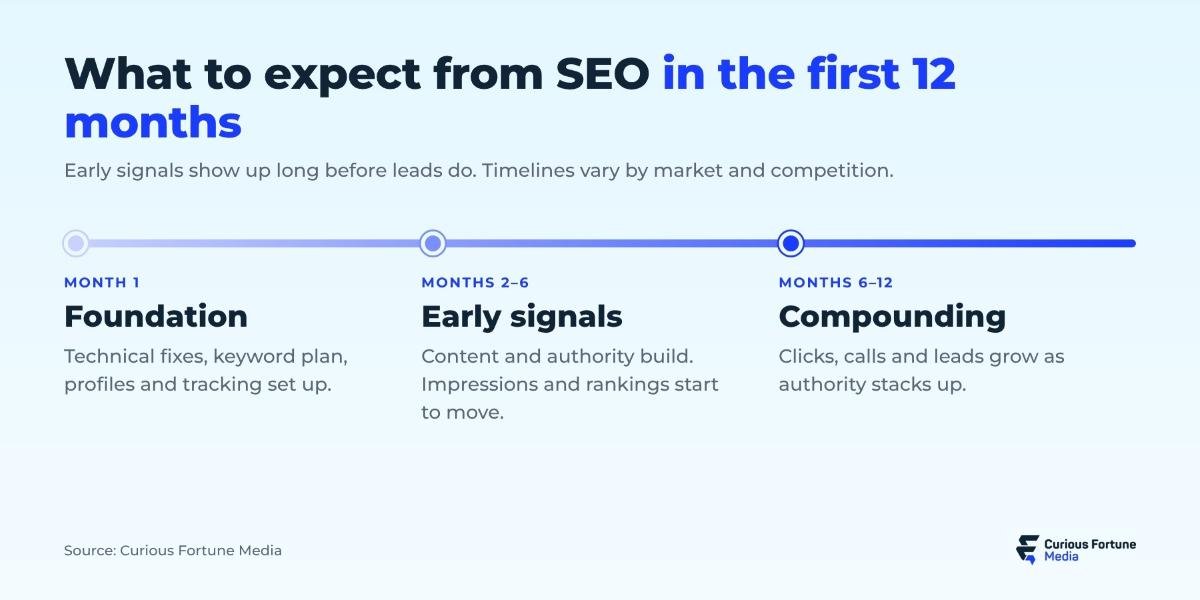
Visibility that compounds takes time, and Abramyan structures his work accordingly. His agency’s engagements run a minimum of one year, so he chooses clients carefully. He looks for true professionals and owners who provide genuine value and are willing to play the long game. He turns away businesses he sees as unwilling to understand the process or not aligned in integrity, and he does not take on owners looking for shortcuts.
He has focused on legal and healthcare professionals, who spend years training in their fields but rarely receive business or marketing training. Many of the owners who reach him have already paid for marketing that didn’t deliver.
“Most people who come to us have been burned before, and it’s usually not because they were careless,” Abramyan says. “They just didn’t know what questions to ask. I didn’t either when I started, so I explain the what and the why before we ever get to the how.”
Explaining the reasoning first is part of the same test. An owner who understands why a piece of work should keep paying off is in a better position to judge whether it actually does.
The Question Worth Asking Each Month
The approach has trade-offs. Work that builds over time is slower to show results than an ad, and no one can promise rankings or a fixed timeline. Some businesses need the immediate lift of paid campaigns, and plenty of them grow that way.
The labor statistics are a reminder that most businesses do not get unlimited time to find out what works. For an owner reviewing next month’s marketing spend, Abramyan’s test fits in a single question: if the payments stopped tomorrow, what would still be working?