

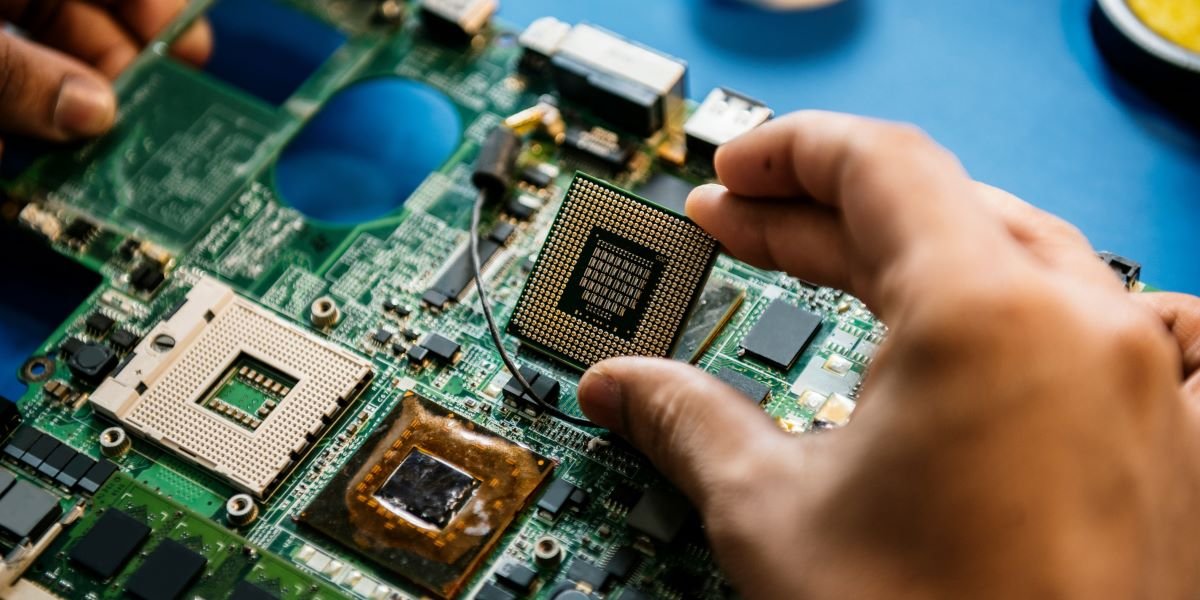
The global semiconductor market is projected to exceed $1.6 trillion in 2026, more than 1.5 times the forecast made earlier this year, as surging investment in artificial intelligence infrastructure by major cloud computing providers in the United States and China rewrites the industry’s growth trajectory and accelerates a shift toward memory-dominated chip spending.
Key Takeaways
- The global semiconductor market is projected to surpass $1.6 trillion in 2026, according to a Korea Eximbank research center report released September 20 based on analysis by market research firms including TrendForce and Gartner.
- Until last year, the global semiconductor market was not expected to exceed $1 trillion until 2030; the timeline has been compressed by at least four years due to AI infrastructure investment.
- Memory chips are expected to account for more than 54% of total semiconductor revenue in 2026, up from 27% in 2025, driven by high-bandwidth memory demand for AI data centers.
- DRAM prices have risen 4.4 times from a year ago and NAND flash prices have increased ninefold, reflecting structural supply tightness as AI workloads expand.
- Geopolitical tensions over chip export controls, the U.S.-China AI rivalry, and questions about critical mineral supply chains add a layer of strategic complexity to the market’s commercial momentum.
A $1 Trillion Milestone Arrived Four Years Ahead of Schedule
The semiconductor industry has effectively compressed a decade of projected growth into two years. As recently as 2025, consensus forecasts placed the global chip market at crossing the $1 trillion threshold no earlier than 2030. That timeline has been abandoned. Korea Eximbank’s research center, drawing on data from TrendForce and other global market research firms, published a report on September 20 projecting total 2026 semiconductor revenue above $1.6 trillion. Gartner’s own forecast aligns with that trajectory, projecting the market will approach $1.94 trillion by 2027.
The acceleration is driven almost entirely by AI. Major cloud computing providers in the United States and China, the hyperscalers that operate the world’s largest data centers, have rapidly increased capital expenditure on AI infrastructure over the past 18 months. That spending is flowing directly into chip orders, particularly for the high-performance processors and memory components required to train and run large language models, generative AI systems, and enterprise AI applications. DIGITIMES Intelligence estimated the year-on-year increase from 2025 to 2026 at approximately 109%, a rate of expansion that has no modern precedent in the semiconductor industry.
Memory Chips Now Account For More Than Half The Market
The most striking structural shift within the semiconductor market is the dominance of memory. Gartner projects that memory revenue will reach $837 billion in 2026 and exceed $1 trillion in 2027. Memory’s share of total semiconductor revenue is expected to climb to 54% in 2026, up from 27% just one year earlier. That near-doubling reflects the reality that AI workloads are extraordinarily memory-intensive, requiring both massive volumes of DRAM for real-time processing and expanding NAND flash storage for the datasets those systems consume.
The pricing environment underscores the demand pressure. DRAM prices stood at approximately $25 as of late August 2026, up 4.4 times from the same period a year earlier. NAND flash prices reached approximately $30.50, a ninefold increase over the prior year. Those are not incremental moves. They represent a fundamental repricing of memory components driven by sustained demand that has outpaced the industry’s ability to add manufacturing capacity at the same speed. Gartner projects DRAM revenue increasing by 246.6% in 2026 and NAND flash revenue rising by 371.9%, figures that illustrate how concentrated the market’s growth has become in a single product category.
AI Data Center Buildouts Are Reshaping Global Supply Chains
The capital flowing into AI infrastructure is not distributed evenly across the semiconductor value chain, and the geographic concentration of that spending carries its own strategic implications. The United States and China account for the overwhelming majority of hyperscale data center investment, and both nations are competing to secure long-term supply agreements with the chipmakers capable of producing the advanced memory and logic components those facilities require. Korea Eximbank’s report noted that major technology companies are pursuing long-term supply contracts with memory manufacturers, a shift from the historically cyclical purchasing patterns that defined the semiconductor industry for decades.
The non-memory segment of the market is also growing, though at a less dramatic pace. Gartner projects non-memory semiconductor revenue increasing by 21.9% in 2026, from $589 billion to $718 billion, driven by demand for power-management chips, analog silicon, and application processors. Employment across the chip industry has also expanded, reaching 174,000 workers in the first quarter of 2026, up from 152,000 in the first quarter of 2018.
Geopolitical Tensions Over Export Controls and Critical Minerals Add Strategic Risk
The semiconductor market’s commercial trajectory is running in parallel with a geopolitical contest over who controls the technology’s critical inputs. U.S. export controls on advanced chips and semiconductor manufacturing equipment remain a defining factor in the industry’s supply chain architecture, restricting the flow of cutting-edge components to Chinese firms and forcing alternative sourcing strategies across Southeast Asia and the Middle East. The upcoming Xi Jinping state visit to Washington on September 24 is expected to place AI governance and chip trade prominently on the bilateral agenda, alongside trade truce negotiations and the Taiwan question.
At the 18th BRICS Summit in New Delhi earlier this month, Chinese President Xi Jinping proposed a BRICS open-source AI community designed to give the bloc’s member nations access to large language models, AI training resources, and a shared digital cloud platform. The initiative was framed as a cooperative development tool for the Global South, but it also functions as a countermeasure to U.S.-led export restrictions by offering alternative pathways to AI capability. India’s Prime Minister Narendra Modi struck a different note at the same summit, warning that the “weaponization of technology and critical minerals” could hinder global development. Modi’s statement, while framed broadly, applies to both U.S. export controls and China’s dominance over rare-earth processing chains, the refined materials essential to semiconductor manufacturing.
The regulatory dimension is equally active. Regulatory frameworks governing AI systems are now being imposed across multiple jurisdictions, including the European Union’s AI Act, China’s Generative AI Services Management Measures, and California’s growing portfolio of AI oversight legislation. Each regulatory regime carries downstream implications for which chips are designed, where they are manufactured, and under what conditions they can be deployed.
Industry Summits This Week Reflect The Sector’s Momentum
The semiconductor market’s velocity is on display this week across three major industry gatherings. The Qualcomm Snapdragon Summit is expected to showcase next-generation mobile and AI processor capabilities. The GMIF Global Memory Industry Innovation Summit in Shenzhen, themed “AI Storage, Driving the Future,” is focused on the memory technologies at the center of the market’s growth. Alibaba’s Cloud Summit in Hangzhou is addressing cloud infrastructure, AI models, and the company’s “five-layer full-stack” approach to enterprise AI. The convergence of all three events in a single week underscores the density of commercial activity in a sector that, two years ago, was still recovering from a cyclical downturn in memory pricing.
The semiconductor industry’s path from $791.7 billion in 2025 revenue to a projected $1.6 trillion in 2026 is not a gentle growth curve. It is a step-function change driven by a technology — artificial intelligence — that demands computing resources at a scale the industry’s existing infrastructure was not built to supply. Whether that demand sustains beyond the current infrastructure buildout cycle, or whether it moderates as AI deployment shifts from training to inference, will determine whether the industry’s next milestone is the $2 trillion mark by 2030 or something faster.
FAQs
How Large Is The Global Semiconductor Market Expected To Be In 2026?
The global semiconductor market is projected to exceed $1.6 trillion in 2026, according to a Korea Eximbank report based on analysis from TrendForce and other market research firms. Gartner projects the market approaching $1.94 trillion by 2027.
Why Has The Semiconductor Market Grown So Quickly?
The primary driver is surging investment in AI infrastructure by major cloud computing providers in the United States and China. Until 2025, the market was not expected to exceed $1 trillion until 2030. Accelerated data center construction and AI chip demand compressed that timeline by at least four years.
What Role Do Memory Chips Play In The Market’s Growth?
Memory chips are expected to account for more than 54% of total semiconductor revenue in 2026, up from 27% in 2025. Gartner projects memory revenue reaching $837 billion in 2026 and exceeding $1 trillion in 2027, driven by high-bandwidth memory demand for AI data centers.
How Are Geopolitics Affecting The Semiconductor Industry?
U.S. export controls on advanced chips restrict supply to Chinese firms, while China has proposed a BRICS open-source AI community as an alternative path to AI capability. India’s prime minister has warned about the “weaponization of technology and critical minerals.” The Xi-Trump summit on September 24 is expected to address AI governance and chip trade directly.
What Major Semiconductor Events Are Happening This Week?
Three major industry gatherings are taking place: the Qualcomm Snapdragon Summit, the GMIF Global Memory Industry Innovation Summit in Shenzhen, and Alibaba’s Cloud Summit in Hangzhou. All three are focused on AI-driven semiconductor demand and infrastructure.