
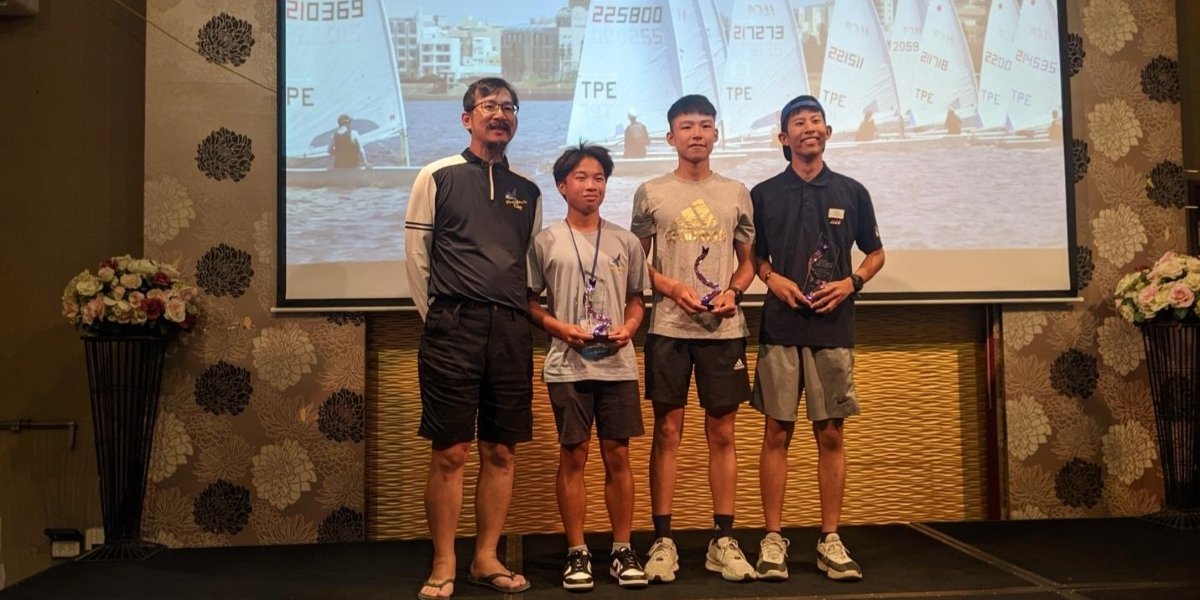
Hao-Ran Hsu was sitting under a team tent in Taiwan, overheated, exhausted and eating lunch after a long day on the water, when someone checked the scores and told him he had finished third. He had not expected a podium. A few days earlier, the 16-year-old American-Taiwanese sailor had barely known the ILCA 4, a single-handed racing boat he had never competed in before. Around him were sailors who had spent years in the class. So, when he placed third at the 2025 Chinese Taipei 114th Academic Year Presidents’ Cup National Sailing Championship, his first feeling was not celebration. It was disbelief. “I kind of had a sense of imposter syndrome,” he said. “I only had five days in the boat, and these other kids had been doing it for years.”
His story could be told as a simple athletic achievement: a teenager works hard, enters a national championship, wins third place, and earns a spot on the Chinese Taipei ILCA Sailing Team after one regatta. But the more interesting story is how he responded to that rise. Hao-Ran describes himself as determined and resilient, which is reflected in his achievements at such a young age.
Before the Presidents’ Cup, he prepared with unusual intensity. He watched more than 100 hours of ILCA footage, studied how to rig the boat, searched for updated photos and videos, created a Google document with notes, and watched Olympic and World Championship races. He focused on the light-wind technique because the Taiwan venue was expected to have lighter conditions. He did not do this to win but to put his best effort. He did it because the trip to Taiwan was expensive, unfamiliar, and important. “I just wanted to do the best I could to make it worthwhile,” he said.
Hao-Ran’s relationship with Taiwan is personal. His parents are from Taiwan, his extended family still lives there, Mandarin is spoken at home, and his family returns at least once a year. Competing for Taiwan felt different from competing in the United States. In Taiwan, the stakes felt higher. He was representing a place tied to his family, identity, and upbringing. “It feels like more of a privilege,” he said. That privilege had not come easily. Hao-Ran began sailing seriously only after seventh grade, when his mother signed him up for a summer race team at Sail Sand Point. He arrived surrounded by younger kids who already seemed far ahead of him. He did not know how to rig the boat or follow the routines. He felt behind.
But within a month, he was competing. By the end of that first summer, he placed first in a Pacific Northwest regional event with 173 sailors. His first coach, Danny, a former Chinese Taipei ILCA Team sailor, noticed his progress, gave him extra instructions, and eventually suggested that he could compete internationally for Taiwan. For a while, Hao-Ran resisted. The pathway involved the ILCA 4, a one-person boat, and he preferred the shared experience of double-handed sailing. He found single-handed sailing lonely. But eventually, he realized that waiting for an ideal opportunity might hold him back. He decided to create one.
At the Presidents’ Cup, that decision was tested immediately. His first race felt uncomfortable. He thought everyone else was faster. His maneuvers felt slow. His confidence was uncertain. Still, he finished second in the men’s division. By the final race, he again finished second, but the meaning had changed. He had spent several more days in the boat. He understood the conditions better. He trusted his own decisions. Instead of simply copying more experienced sailors, he adjusted his angles, applied what he had learned about light-wind sailing, and nearly passed the first-place boat before being caught at the line.
The two races produced the same result. But they revealed a different Hao-Ran. In the first, he was learning how to survive at that level. In the end, he was beginning to belong. The third-place finish led to his selection as one of four Chinese Taipei ILCA 4 sailors. The news came suddenly, only weeks before the Asian Cup. His mother received the message, joined a call, and then told him he was on the team and needed to return to Taiwan soon.
The achievement might have inflated his confidence, but the next competition grounded him. At the ILCA Asian Cup Penghu 2026, Hao-Ran finished last in all three races on the first day. The conditions were heavy, the competition was stronger, and the level was far beyond what he had experienced nationally. He realized that Asia-level competition was an entirely different standard. After the Presidents’ Cup, he said, he had begun to convince himself that maybe he was “that good.” After the Asian Cup, he understood the danger of believing that too easily. “You have to keep yourself grounded,” he said.
That may be the most important part of Hao-Ran’s story. His results are impressive, but he does not want to be defined by them. He is more interested in improvement than praise. That mindset appears outside racing, too. As a sailing camp assistant counselor, he teaches children, teenagers, and adults at different skill levels, adapting his explanations to everyone from eight-year-old beginners to adults learning a new boat.
Hao-Ran hopes to move into the 470 class, a powerful double-handed Olympic boat related to the 420 class he sails in the United States. He is also interested in medicine, especially anesthesiology, which combines chemistry, biology, calm judgment, and pressure.
For Hao-Ran, the goal is not simply to win. It is to improve, stay humble, and keep moving forward.