


A HomeWise closing can happen in as little as seven days once title is clear, and the seller may choose any date up to 60 days out. Title is clear when the title company has confirmed who owns the house, found every lien and judgment against it, and holds payoff figures. Probate, a missing signature or an unreleased old mortgage stretch that week into a month.
Consider a hypothetical owner in Killeen, Texas, who accepted a cash offer of $196,000 on June 8, 2026, with a new job starting in Denver three weeks later. The search turned up a second mortgage recorded in 2011, paid off years earlier by a lender since folded into another bank, with no release ever filed. Chasing that one piece of paper took 19 days. A seven day close became a 24 day close, and the buyer’s money never changed.
What does title is clear actually mean?
It means a title company has read the public record on the property and is willing to insure the transfer. Three questions get answered: who owns the house today, what is recorded against it, and what has to be paid or released at closing so the deed passes clean. Ownership comes out of the chain of deeds. The rest comes out of the liens, judgments, tax rolls and court files tied to the address and to the owner’s name.
How long do title searches take?
Days when the record is tidy, weeks when it is not. Title agencies pull the chain of title first, then search the registries that hold everything a creditor or a court can attach to a house. According to the American Land Title Association’s August 2024 analysis of the property record, various entities filed 1.9 million court judgments or orders, almost 900,000 local, city, utility and other government related liens, and 600,000 state and federal tax liens in the twelve months from October 2022, in a country with more than 3,500 deed recording jurisdictions. The association describes the work this way: “This means when you get ready to close on your new house, your title insurer will review the relevant documents, identify errors in the public record or other potential problems, and help to resolve them so the title can be traded without incident.”
Between contract and closing table, the file moves through the same steps.
- The order is opened. The contract goes to a title company or closing attorney, a file number is issued, and the search is ordered.
- The record is searched. Deeds, mortgages and deeds of trust, court judgments, state and federal tax liens, unpaid property taxes, association assessments, easements and any lawsuit touching the property.
- A commitment is issued. It lists what the title company will insure and, more useful to a seller, the requirements to be satisfied before it insures anything.
- Payoff figures are ordered. Each lender, taxing authority and lienholder states in writing what it will take to release its claim and through which date that number holds.
- Curative work is done. Releases are obtained and recorded, affidavits are signed, an estate is opened or an heir located, a name mismatch on an old deed corrected.
- The file closes. The seller signs, funds are disbursed to the payoffs and to the seller, and the deed and releases go to the county for recording.

Why does an unreleased lien stop a closing?
Because paying a debt and clearing the record are two separate acts. The county keeps what was filed and cannot edit it. The Los Angeles County Registrar-Recorder and County Clerk puts the limit in one line on its page on liens: “By law, the County Recorder cannot make any changes or alterations on a lien document.” The same page defines the thing itself: “A lien is an encumbrance that makes property security for the payment of a debt or discharge of an obligation.” Removing one takes a release signed by the party that filed it, usually notarized, then recorded in that county. When the filer has merged or shut down, the release becomes a chase.
What stretches a seven day close?
Almost always something in the record rather than something in the offer. A cash buyer takes loan underwriting, the appraisal and the lender’s schedule out of the picture, leaving the file as the only real variable. The usual items:
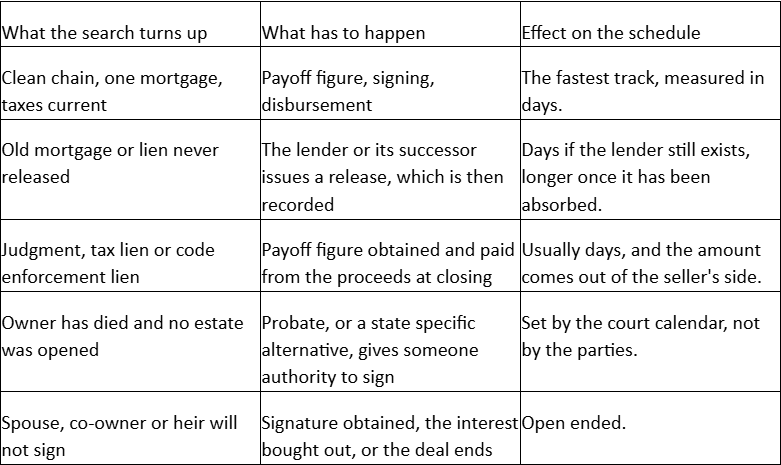
Where does a direct buyer fit?
HomeWise, a direct home-buying company that purchases distressed single-family houses in California, Texas, Florida, Arizona, Georgia and other states, buys as-is with its own capital, which removes mortgage approval and the appraisal from the timetable. The company says it can close in as little as 7 days once title is clear, that the seller picks the date up to 60 days out, and that it charges no agent commissions, listing fees or service fees while covering standard closing costs in most cases; prorated property taxes and association dues owed at settlement still apply. Its how it works page adds that a licensed title company handles the closing, confirms clear ownership and clears liens or back taxes from the proceeds.

Buyers such as HomeWise ask for the payoff statement and the exact name on the deed early, because those two documents decide whether a one week close is realistic. An owner facing probate, a disputed lien or a co-owner who cannot be reached should have a licensed attorney in the state review the file, since a court and a statute set that timetable, not the buyer.
Frequently asked questions
Does searching “sell my house fast” get a faster closing?
No. A search finds buyers; the county record sets the pace. Paying cash takes financing out of the schedule, so a clean file can close inside a week, while an open estate, an unreleased lien or a missing signature holds the same house for a month.
What does close of escrow mean, and when does the seller get paid?
Close of escrow is the moment the escrow or title agent records the deed and disburses the money, and across much of the western United States it is the ordinary name for closing day. Sellers are typically paid that day or the next, by wire or check, once recording is confirmed.
Can a house in probate close in seven days?
Seldom. Someone has to hold court authority to sign the deed, and that authority arrives on the court’s calendar. Once letters are issued and any required notice or confirmation is finished, the closing moves at normal speed, which is why estate work is the part to start early.
What if an old mortgage was paid off but never released?
The title company asks the lender or its successor for a release and records it. Canceled checks, the old settlement statement and a payoff letter help. If the lender no longer exists, most states provide a statutory route to clear the record, and that is where a real estate attorney saves days.