

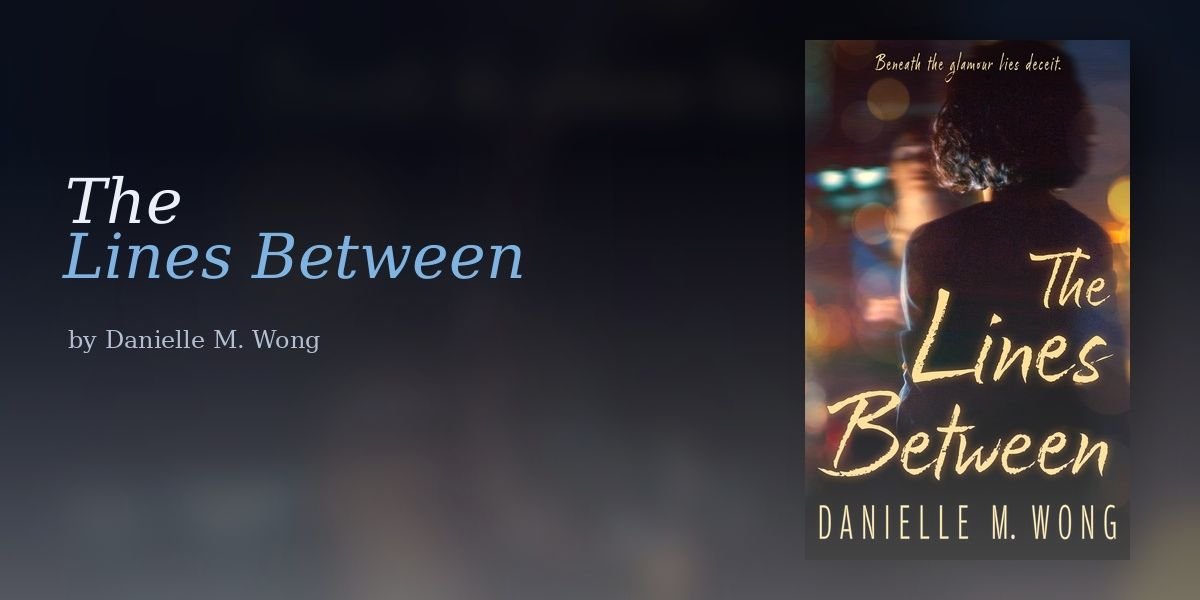
By: Raquel Homes
Danielle M. Wong opens The Lines Between in a world that most readers have spent their entire lives consuming from the outside: the world of Hollywood celebrity, of red carpets and magazine covers and the carefully managed public personas of people whose private lives are the subject of universal fascination and very selective disclosure. And then she takes that world apart, piece by piece, with the methodical intelligence of a writer who understands that the most effective thrillers are not the ones with the most shocking revelations but the ones that make those revelations feel inevitable in retrospect, the natural consequence of a world built on performance and deception and the management of other people’s perceptions.
Stevie Young is a celebrity assistant, which means she has made a professional life of knowing things and saying nothing, of managing the distance between what her clients are and what they allow the world to see. When she starts working for Dean Bennington and Lana Lim, she believes this is simply another version of the same work she has always done. The mysterious injury that befalls Lana, and the explosive chain of events that follows, disabuse her of that comfortable belief with a thoroughness that keeps the reader turning pages well past any reasonable stopping point.
What Wong does so effectively throughout the novel is maintain the sense that every piece of information Stevie receives might be true or might be another layer of performance, another story being managed by someone whose relationship to authenticity has been complicated by years of professional image-making. That sustained uncertainty is where the novel’s psychological tension lives, and Wong sustains it with a craft and a discipline that reflects a writer working at a genuinely high level of control over her material.
The lush glamour of the Hollywood setting functions throughout the book as an ironic counterpoint to the darkness being slowly revealed underneath it, and that irony is one of the novel’s most consistent pleasures. The contrast between the world as Stevie’s clients need it to appear and the world as it actually is becomes increasingly acute as the novel progresses, until the gap between them is so wide that the performance required to maintain it has become its own kind of violence. Wong handles that escalation with the pacing intelligence of a writer who has thought carefully about the relationship between her story’s emotional arc and its plot mechanics, and the result is a novel that keeps building in ways that feel both surprising and inevitable.
The Lines Between is sophisticated, propulsive, and deeply satisfying in the way that only well-constructed psychological suspense can be, and it is the novel that establishes Wong as one of the most accomplished practitioners of the form currently working.
If the specific tension of a world where everyone is always performing, and nobody is quite sure what the performance is concealing, sounds like exactly the kind of psychological suspense you have been looking for, The Lines Between by Danielle M. Wong is on Amazon right now, and it delivers that tension with exceptional skill and exceptional intelligence. Head over and grab your copy today before you start another book that is not this good.