


Underwriters rarely explain their reasoning to applicants. So let’s look over one’s shoulder. Below are five fictional applications for working capital, each with the kind of margin notes an experienced reviewer might write while reading the file. Every one reveals a separate rule about qualifying, and together they show what a one-day approval really depends on.
These profiles are composites for teaching purposes. Actual requirements and outcomes vary by provider.
File 1: Bella’s Bistro
Request: $30,000 for a new hood system and a summer staffing bump
Time in business: 4 years
Average monthly deposits: $85,000
Personal credit: 655
Negative days in 90: 0
Existing debt: none
Reviewer’s notes:
*Clean file. Deposits are daily and steady. Request is about a third of one month’s revenue. Credit is average but not a concern. Purpose is clear. All documents received at once. Can move today.*
The lesson: Modest requests relative to deposits move fastest. Bella’s asked for an amount her statements easily justified, and she’d assembled all of her documents ahead of time. Average credit didn’t hurt, because everything else was clean.
Her file also shows why the choice of product matters. A provider’s page like Fundivi short-term working capital lists the typical expectations, and comparing those with your own numbers before applying prevents wasted effort.
File 2: Ridgeline Roofing
Request: $120,000 for materials on three new jobs
Time in business: 7 years
Average monthly deposits: $140,000, ranging from $35,000 to $310,000
Personal credit: 710
Negative days in 90: 2
Existing debt: truck loans
Reviewer’s notes:
*Deposits are lumpy, which is normal for contractors, but I can’t confirm the pipeline from statements alone. Need signed contracts and last year’s seasonal pattern. Request is large. Good business, not a same-hour decision.*
The lesson: Uneven revenue isn’t disqualifying if you explain it. Had Ridgeline included its signed contracts, a schedule of expected payments, and statements from the previous season, the reviewer might have needed no further information. Anticipate the question that your statements raise, and answer it in the package.
Additional documents that help project-based businesses:
- Signed contracts with payment milestones
- Work-in-progress or job schedule
- Accounts receivable aging report
- Twelve months of statements showing a full season
File 3: Sunrise Home Care
Request: $60,000 for payroll while Medicaid reimbursements catch up
Time in business: 2 years
Average monthly deposits: $95,000
Personal credit: 590
Negative days in 90: 11
Existing debt: two daily advances, totaling $2,100 per day
Reviewer’s notes:
*Two positions already taking about 45% of deposits. Eleven negative days. Adding a third would likely cause default. Decline or restructure only. Possible receivables-based option because of government payers.*
The lesson: Existing obligations can outweigh strong revenue. Calculate your own number: $2,100 per day, over about 21 business days, comes to roughly $44,100 per month, or nearly half of Sunrise’s deposits.
If you’re in this position, more short-term debt is rarely the solution. Consider speaking with your current funders about reconciliation, examining a receivables-based product, or getting independent advice. Reading about lending platforms sought after by small firms can give you a sense of what’s out there, though stacking additional debt on top of a strained position should be approached very cautiously.
File 4: Pixel & Press Print Shop
Request: $25,000 for paper inventory
Time in business: 3 years
Average monthly deposits: $38,000
Personal credit: 720
Negative days in 90: 1
Existing debt: none
Reviewer’s notes:
*Good file on paper, but application says “Pixel & Press,” bank account says “PP Graphics LLC,” and state record shows “PP Graphics Printing LLC.” Secretary of state shows status as delinquent. Hold until cured and names reconciled.*
The lesson: Administrative mismatches stop good applications. Pixel & Press could qualify, but a late annual report and three different names on its paperwork turned a same-day file into a week-long process.
Before you apply, make sure these four items agree exactly:
- The legal name on your state registration
- The name tied to your EIN
- The name on your bank account
- The name on your application, with any “doing business as” name noted
Then look up your business on your state’s website to verify that it’s in good standing. It takes two minutes.
File 5: Maple Street Market
Request: $40,000 to “get ahead on bills”
Time in business: 18 months
Average monthly deposits: $62,000, falling for five straight months
Personal credit: 640
Negative days in 90: 6
Existing debt: none
Reviewer’s notes:
*Deposits down 30% since spring. No explanation given. Purpose is vague and suggests operating shortfall. Is the decline temporary? Need more information. Reduced amount possible only if there’s a credible plan.*
The lesson: Falling revenue requires a story supported by evidence. If a road closure or competitor’s opening hurt your business, say so, and describe what you’ve done about it. “Get ahead on bills” tells the reviewer that the money won’t produce anything new, and it raises the question of how repayment will happen.
A stronger purpose statement might read like this: “Sales fell during a four-month street closure that ended in September. October deposits are up 18%. We’re requesting $20,000 to restock seasonal goods before the holidays.”
What the Five Files Teach
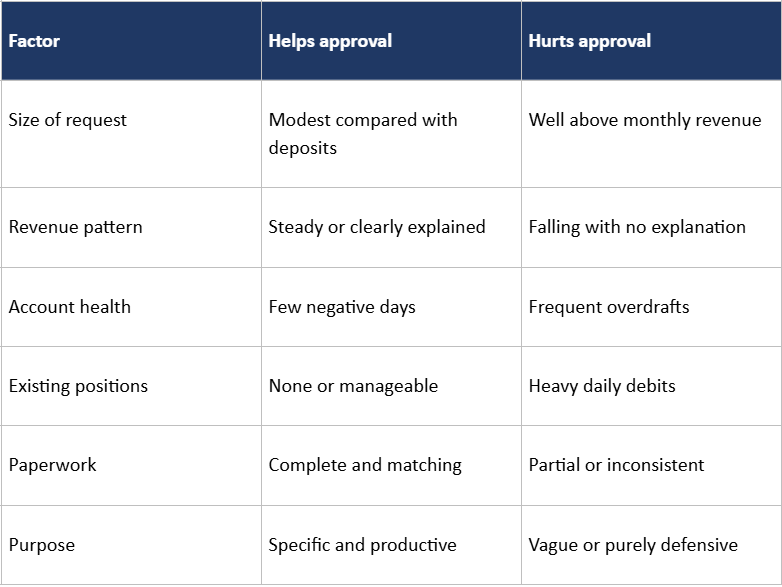
Comparison sites, including the BusinessLoansCompanies.com working capital reviews, may help you find providers whose standards fit your profile.
Your Own Reviewer’s Note
Now write one about yourself. Fill in these fields honestly:
- Request as a percentage of monthly deposits
- Revenue trend, with an explanation for any decline
- Negative-balance days in the last 90 days
- Existing daily or weekly debt payments
- Whether all names and registrations match
- Purpose in a single, specific sentence
If you were the reviewer, would you approve this file today? If not, you’ve found precisely what to fix.
Timing the Application
Once your file is ready, submit it early on a weekday and stay available. Reviewers commonly make one short verification call. Ask how funds will be sent and what the cutoff is. Approval and timing remain at the provider’s discretion, and no one should guarantee them before reviewing your information. Owners who prefer predictable payments can also review this Benzinga report on fast term funding, which outlines an alternative with a defined repayment schedule.
How a Reviewer Reads the First Page of Your Statement
Reviewers tend to work in a set order. They begin with the beginning and ending balances for each month, looking for a trend. They move on to total deposits, then strip out anything that isn’t revenue. Next, they count returned items and negative days. Finally, they scan the withdrawals for recurring debits to other funders, as well as unusual payments to owners. It takes only a few minutes, and an experienced reviewer can spot trouble quickly. Do the same with your most recent statement, in that order, and note every line a stranger might question. Whatever you find, write a sentence or two about it and include it with your file.
Frequently Asked Questions
What’s the minimum revenue for a fast working capital loan?
It varies. Many providers set a monthly or annual minimum, and larger offers need higher deposits.
Do I need a business bank account?
Almost always. Using a personal account for business makes verification harder and may disqualify you.
Can I qualify with existing advances?
Sometimes, if deposits comfortably support them and your agreements allow additional funding. Heavy positions often lead to decline.
How many months of statements are required?
Commonly three to six. Seasonal or larger requests may need twelve.
Does the reason for borrowing matter?
Yes. A specific, productive purpose makes approval easier and helps you evaluate the cost.
Will I need to give my online banking login?
Some providers use secure connections, while others accept PDFs. Ask what’s required and how your data is protected.
Why would I be approved for less than I requested?
Offers depend on deposits, debts, and risk. A reduced amount often reflects what your cash flow appears able to support.
Does a recent address change matter?
It can slow verification, so update your bank and state records first and keep proof of the new location handy.