
Climate change can alter the future of a species before it has even left the egg.
For sea turtles, warmer nesting temperatures produce more female hatchlings. As beaches heat up, that imbalance can become increasingly extreme, threatening the future of entire populations.
It is one of the less visible consequences of a warming planet, and one that 17-year-old Vienna Yandhana encountered while working with sea turtles in Bali.
During a month at a turtle conservation centre, Vienna cleaned pools, assisted stranded hatchlings and, alongside her team, helped rescue three sea turtles following severe weather. Yet what stayed with her was not only the act of rescue. It was the uncomfortable realisation that by the time an animal needs saving, the forces threatening it may have been developing long before anyone sees the damage.
Again and again, when she encounters a problem, she seems less interested in simply responding to its consequences than in moving backwards: towards the conditions that created it, the people who could intervene earlier and the point at which prevention might still be possible.
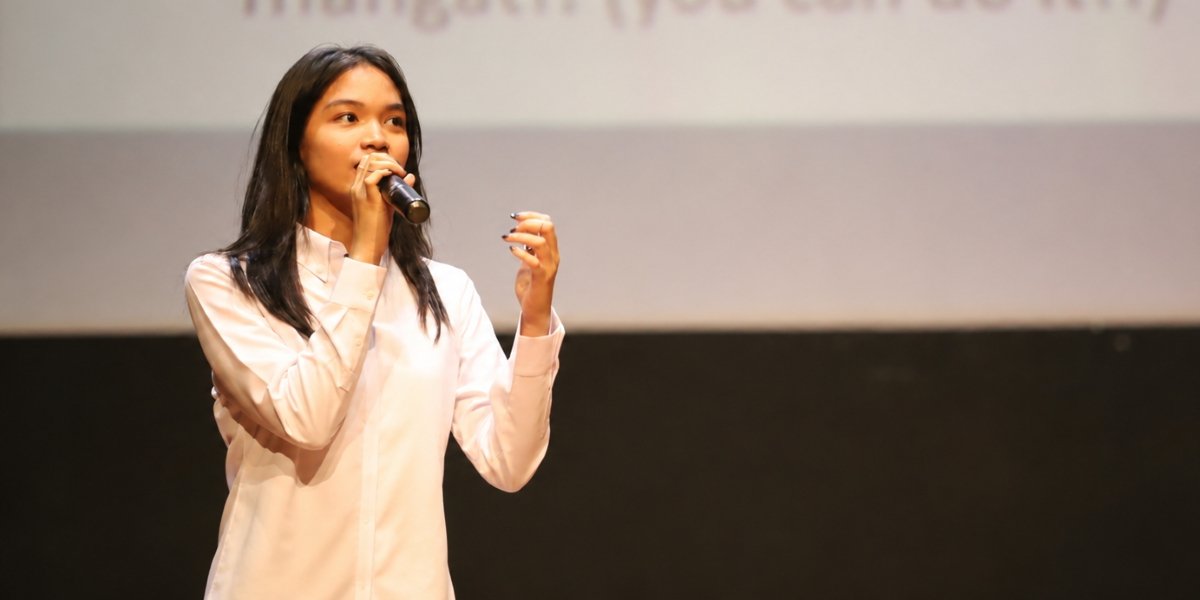
She had already begun doing exactly that at 15, when she founded Thalassic Journal.
Vienna was growing up in a country defined by the sea, yet she felt there was a strange distance between young Indonesians and the environmental issues unfolding around them. Marine conservation was visible as a cause, but to her, visibility was not the same thing as understanding. A warning about coral loss could be scrolled past. A scientific explanation could feel impenetrable. And simply telling someone that the ocean was in danger did not necessarily make them care about why.
So Vienna began experimenting with a different language for conservation.
On Thalassic, coral bleaching becomes “Bleached and Bothered”. Ocean acidification becomes “Sour Seas”. A feature on coastal erosion begins by asking what happens when someone returns to a beach years later and realises half of it has disappeared. Deep-sea mining, shark finning and mangrove ecology are unpacked through bold graphics, humour, case studies and research references rather than presented as subjects young people are expected to already understand.
The point was never to make science less serious. It was to make it easier to enter.
What started with Vienna has since developed into a youth-led organisation of around 30 members. She built roles around the work, bringing together researchers, writers and graphic designers, and introduced a more formal recruitment structure as the organisation grew beyond her immediate school circle. More than 70 pieces of marine-biodiversity content have now been published across its social platforms.
As Thalassic grew, Vienna became increasingly deliberate about how the organisation should develop. Rather than chasing one-off projects, she focused on building a model that could be sustained: clear roles, consistent publishing, and work that played to the strengths of a youth-led team. The shift gave Thalassic a stronger identity and helped turn an early idea into something more structured and lasting.
The result was a model built around consistency rather than spectacle: research a problem, make it understandable, give young people a reason to stay with it, then find ways for that awareness to move beyond the screen.
For Vienna, founding Thalassic was not simply an attempt to tell more people that Indonesia’s oceans were under threat. It was an attempt to change the point at which they began paying attention.
Soon, that work was moving off the screen.
During a mangrove conservation effort, Vienna and other volunteers worked directly in the mud, preparing the ground and planting more than 100 mangrove seeds. After flooding left rubbish across the conservation area, the group also helped clear waste from the site. For Vienna, it was another way of closing the distance between understanding an environmental problem and physically participating in its restoration.
But perhaps the clearest expression of the way she thinks is taking shape away from the coastline.
In Karangasem, Bali, Vienna is helping turn an unused building into a community library and learning space. The project began as she thought about limited educational access in the area and the wider consequences that can follow when young people, particularly girls, have fewer opportunities to learn, encounter different professions and imagine futures beyond those immediately around them.
Rather than approaching issues such as low literacy or pressures towards early marriage only at the point when their consequences become visible, Vienna began asking what could widen those choices earlier.
Her answer was education.
Working with her family, a local entrepreneur and neighbourhood leadership, Vienna helped secure permission to begin transforming the building. The project is still in development: repairs are needed, books are being collected, and the space is gradually taking shape. Eventually, she hopes it can become more than a library, with seminars, visiting professionals, cultural activities and hands-on learning available to local students and families.
Vienna often returns to an Indonesian expression: a book is a window to the world. For her, the significance lies not only in the book, but in making sure there is a window there to open.
Across projects that may initially seem very different, the instinct is remarkably consistent. A stranded turtle leads her towards the conditions threatening its species. Marine awareness leads her towards restoration. Concern about the choices available to young people leads her towards creating a place where those choices might begin to expand.
Sometimes, the more powerful question is how far back you are willing to go to find where it began.