
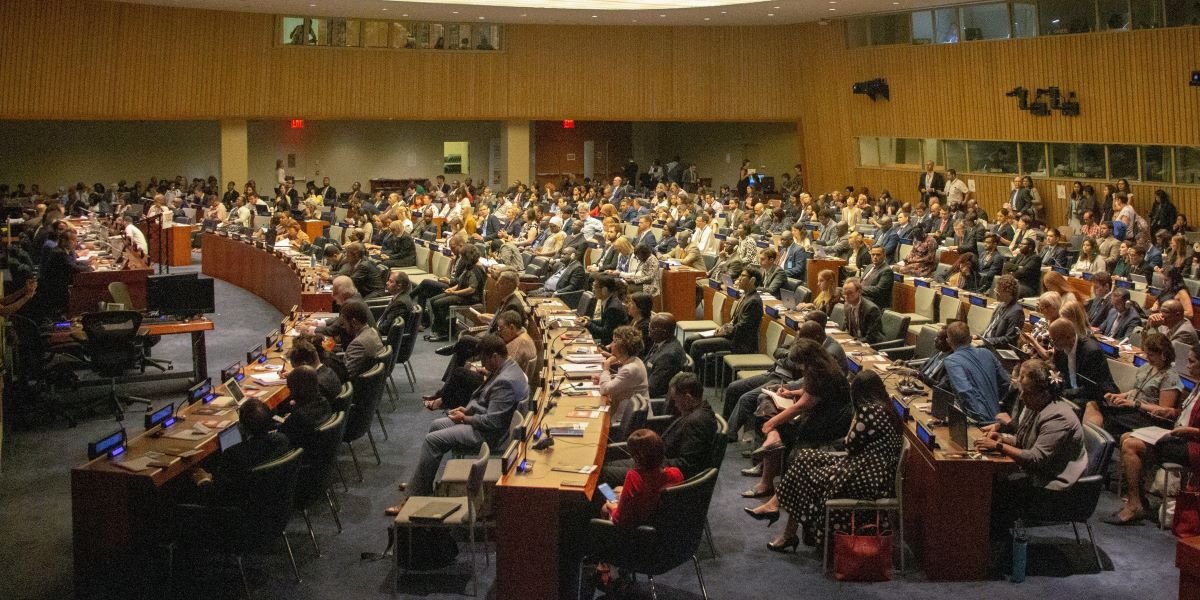
The 81st session of the United Nations General Assembly opens at UN Headquarters in New York on September 8, with heads of state and government convening for the annual high-level week beginning September 22. Presided over by Khalilur Rahman of Bangladesh under the theme “Restoring trust, managing transformation: A United Nations that delivers for all,” this year’s session takes place against a backdrop of decelerating global growth, rising sea levels, and a leadership transition at the top of the organization, as Secretary-General António Guterres’s term concludes on December 31, 2026.
Key Takeaways
- The UNGA 81st session opens September 8 in New York; the high-level General Debate runs September 22–26 and 28, with world leaders addressing global priorities across security, development, and climate
- The UN World Economic Situation and Prospects 2026 report projects global growth at 2.7% this year, below the pre-pandemic average of 3.2%, with global trade growth slowing to 2.2%
- Four dedicated high-level meetings anchor the week: climate action and the just energy transition (September 23), sea-level rise (September 24), pandemic preparedness (September 25), and the 40th anniversary of the Declaration on the Right to Development (September 23)
- More than 500 million people live in low-lying coastal zones threatened by accelerating sea-level rise; global sea levels rose at a record rate of 5.9 millimeters in 2024
- Global FDI rose 6% to $1.6 trillion in 2025, but the UNCTAD World Investment Report found recovery remains uneven, with developing economies facing disproportionate barriers to capital flows
- Secretary-General Guterres’s term ends December 31, 2026, making this session a consequential inflection point for the organization’s leadership and institutional direction
The Economic Landscape Heading Into the General Debate Has Shifted Toward Caution
The economic data framing this year’s General Assembly paints a picture of a global economy that has avoided a contraction but is struggling to generate momentum. The UN’s World Economic Situation and Prospects 2026 report, produced jointly by the Department of Economic and Social Affairs, UNCTAD, and the five regional commissions, projects global output growth at 2.7% in 2026, down from 2025 levels and still short of the 3.2% pre-pandemic average.
Global trade, once the engine of post-crisis recovery, is expected to grow at just 2.2% in 2026. The report identifies geopolitical fragmentation, elevated trade restrictions, and climate-related supply disruptions as the primary drags on international commerce. Inflation has eased considerably across most economies, falling to approximately 3.1% globally, but the report emphasizes that rising living costs continue to strain household budgets, particularly in low- and middle-income countries where wages have not kept pace with cumulative price increases since 2020.
High debt levels and tight public budgets are limiting essential investments in infrastructure, health, and education in many developing economies. The global unemployment rate is projected to edge down slightly to 4.9% in 2026, but the figure masks substantial regional variation. South Asia is expected to lead regional growth at 5.6%, driven largely by India’s 6.6% expansion. Africa is projected at 4.0%, marginally higher than 2025 but still constrained by debt burdens and climate vulnerability. Western Asia is forecast at 4.1%, though security risks and geopolitical instability remain persistent headwinds.
Foreign Direct Investment Is Recovering, but Not Where It Is Needed
The UNCTAD World Investment Report 2026, released in July, found that global foreign direct investment rose 6% to $1.6 trillion in 2025. The headline figure, however, obscures a structural imbalance. Investment flows remain concentrated in developed economies and a handful of emerging markets with established capital infrastructure, while many developing countries, particularly in Sub-Saharan Africa and small island states, continue to face barriers to attracting the kind of long-term capital that supports industrial development and climate adaptation.
UNCTAD’s analysis noted that the investment landscape is becoming “more selective, more strategic, and more concentrated,” with geopolitical considerations increasingly shaping where and how capital moves. The report flagged that while the aggregate recovery is real, the development impact of that investment is not automatic. For many of the delegations arriving in New York, the gap between global FDI totals and the investment reaching their own economies will be a central point of tension during the week’s negotiations.
Climate Action and Sea-Level Rise Anchor the Week’s Thematic Agenda
Secretary-General Guterres will convene a high-level meeting on climate action and the just transition on September 23. The meeting comes ten years after the Paris Agreement and at a point when, as the UN has acknowledged, climate overshoot is now considered inevitable. Leaders will take stock of progress on the energy transition, climate finance for developing countries, and adaptation strategies for communities already experiencing the consequences of warming.
The following day, September 24, the General Assembly will hold a dedicated high-level meeting on the existential threats posed by sea-level rise. A political declaration negotiated in advance of the session is expected to be adopted. The data driving the meeting is stark: global sea levels rose at an average rate of 4.7 millimeters per year between 2014 and 2023. In 2024, that rate accelerated to a record 5.9 millimeters. More than 500 million people live in low-lying coastal zones, with small island developing states and countries like Fiji, Vanuatu, and the Solomon Islands already experiencing displacement.
The September 25 meeting on pandemic prevention, preparedness, and response follows the May 2025 adoption of the WHO Pandemic Agreement. That session will assess whether the political commitments made during the agreement’s negotiation are translating into the financing and institutional capacity needed to respond to future health emergencies.
A Leadership Transition Adds Institutional Stakes to the Session
The 81st session coincides with the final months of Secretary-General Guterres’s tenure. The General Assembly appoints the Secretary-General on the recommendation of the Security Council, and the selection process for the next occupant of the role will proceed in parallel with the session’s substantive agenda. The outgoing Secretary-General has used the lead-up to the session to press member states on climate action, development financing, and AI governance, framing the current moment as one in which “economic, geopolitical and technological tensions” are reshaping the global landscape.
President of the General Assembly Khalilur Rahman, a Bangladeshi diplomat with more than four decades of experience in international affairs, will preside over the session. His selection reflects the membership’s interest in a president from a climate-vulnerable developing country at a time when adaptation financing and loss-and-damage mechanisms remain unresolved. Rahman’s stated priorities include peace and security, SDG acceleration, climate and environment, human rights, governance of emerging technologies including artificial intelligence, and UN institutional reform.
Side Events Extend the Week’s Reach Beyond the General Assembly Hall
The SDG Moment, scheduled for September 18, precedes the formal start of the high-level week and is designed to generate momentum for the Sustainable Development Goals with less than four years remaining before the 2030 deadline. The World Economic Forum will hold its Sustainable Development Impact Meetings from September 21–24 in New York, running in parallel with the General Assembly and convening leaders from business, government, and civil society around development financing, climate resilience, and institutional cooperation.
The broader calendar surrounding UNGA 81 extends into the fall. COP31, the UN Climate Change Conference, is scheduled for November in Antalya, Turkey. The outcomes from the September climate and sea-level meetings are expected to shape the negotiating positions that delegations carry into that conference, making the General Assembly week a critical staging ground for the year’s remaining multilateral agenda.
FAQs
When Is the UN General Assembly 81st Session?
The 81st session formally opens on September 8, 2026, at UN Headquarters in New York. The high-level General Debate, where heads of state and government deliver statements, runs from September 22 through 26 and continues on September 28. The broader high-level week spans September 22–28.
What Is the Theme of UNGA 81?
The theme is “Restoring trust, managing transformation: A United Nations that delivers for all.” The session is presided over by Khalilur Rahman of Bangladesh, who took office as President of the General Assembly on September 8.
What Are the Major Meetings During the High-Level Week?
Four dedicated high-level meetings are scheduled alongside the General Debate. On September 23, Secretary-General Guterres will convene a climate summit focused on the just energy transition. That same day, the Assembly marks the 40th anniversary of the Declaration on the Right to Development. September 24 is dedicated to the existential threats of sea-level rise, with a political declaration expected. September 25 focuses on pandemic prevention, preparedness, and response.
Why Does the Global Economic Slowdown Matter for This Session?
The UN projects global growth at 2.7% in 2026, below the 3.2% pre-pandemic average. Global trade growth is expected at just 2.2%. For many developing countries, slower growth combined with high debt and limited fiscal space means less money available for public investment in health, education, and climate adaptation, all of which are central to the session’s agenda on the Sustainable Development Goals.
What Is the Significance of the Sea-Level Rise Meeting?
More than 500 million people live in low-lying coastal zones. Global sea levels rose at a record rate of 5.9 millimeters in 2024, up from an average of 4.7 millimeters per year over the preceding decade. Small island developing states and low-lying coastal communities are already experiencing displacement. The September 24 meeting is expected to produce a negotiated political declaration committing member states to international cooperation on resilience and adaptation.
Is This Secretary-General Guterres’s Final General Assembly?
Secretary-General António Guterres’s term ends on December 31, 2026. The General Assembly appoints the next Secretary-General on the recommendation of the Security Council, and the selection process will proceed during the 81st session. This makes the session a pivotal moment for both the organization’s substantive agenda and its institutional leadership.