
By: Alva Ree
In a world moving at extraordinary speed, where technology connects continents and trends change overnight, small cultures often face a difficult question: how do you preserve identity without becoming trapped in the past?
For Georgian poet and cultural figure Giorgi Ramazashvili, the answer is surprisingly simple.
“Tradition is not a museum exhibit,” he says. “It has to live among people. It has to be spoken, sung, and felt.”
For years, Ramazashvili has dedicated his work to preserving and promoting the cultural heritage of Georgia, particularly the traditions, language, and folklore of Tusheti, one of the country’s most distinctive mountain regions. While many artists focus on creating something entirely new, he has chosen a different path, ensuring that valuable pieces of the past remain relevant in the present.
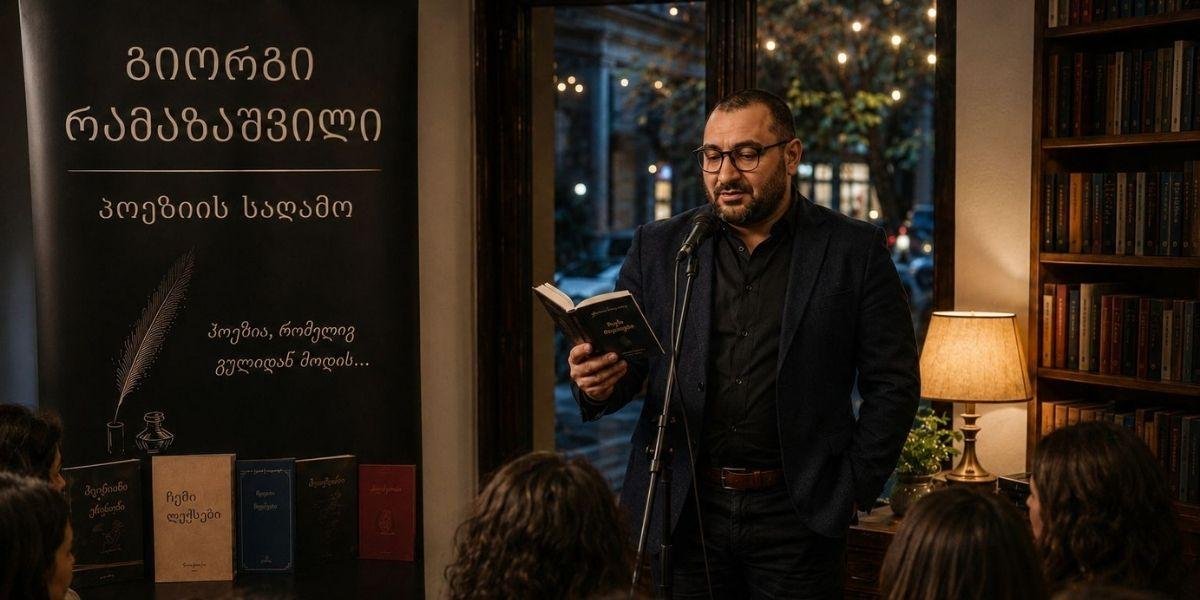
His poetry exists at the intersection of history and modernity. Writing both in contemporary Georgian and in the Tushetian dialect, he creates work that serves not only as literature but also as cultural preservation. At a time when regional dialects around the world are disappearing, his writing has become a way of protecting a voice that might otherwise be lost.
“Every dialect carries a different way of seeing the world,” he explains. “When a language disappears, we lose more than words. We lose memories, stories, and a unique understanding of life.”
This philosophy has shaped his career and distinguished him from many contemporary literary figures. Rather than separating art from cultural responsibility, Ramazashvili views them as inseparable.
His work has reached audiences far beyond Georgia through literary events, publications, and cultural programs held across Europe and the United States. Yet his focus remains remarkably grounded.
“I don’t write to become famous,” he says. “I write because there are stories that deserve to survive.”
Those stories have found their way into poetry collections, newspapers, literary journals, and musical compositions. Many of his poems have been adapted into songs and performed by respected Georgian singers and folk ensembles, creating another bridge between traditional culture and modern audiences.
But poetry represents only one part of his creative identity.
Ramazashvili is also known for performing traditional Tushetian melodies on the accordion, bringing centuries-old musical traditions to contemporary stages. Watching him perform, it becomes clear that music and poetry serve the same purpose in his life: they are both methods of preserving memory.
“Music reaches places that words cannot,” he says. “Sometimes a melody can explain a nation better than a book.”
That belief has guided much of his work abroad.
During several years spent in Italy, Ramazashvili became an informal ambassador of Georgian culture, introducing audiences to the country’s folklore, literature, and artistic traditions. Rather than presenting culture as something distant or exotic, he focused on finding common ground between people.
The experience reinforced a lesson he continues to emphasize today.
“The more you learn about another culture, the more you understand your own,” he says.
His journey later brought him to the United States, where he continues to engage with diverse audiences while promoting cross-cultural dialogue through literature and the arts. For him, cultural exchange is not about exporting traditions but about creating conversations.
This perspective has shaped his career. Yet those who know him often describe him not through accolades, but through his dedication to the work itself.
There is a quiet consistency to his work. While his audience has grown, his mission has remained unchanged: to keep alive the stories, language, music, and values that shaped generations before him.
In many ways, his work raises a broader question about the future of cultural identity in the modern world.
Can traditions survive without people willing to carry them forward?
For Ramazashvili, the answer lies not in institutions or governments, but in individuals.
“Culture survives because someone chooses to protect it,” he says. “Someone writes the poem. Someone sings the song. Someone teaches the next generation.”
That belief continues to guide his artistic journey today.
As globalization reshapes societies and younger generations navigate increasingly interconnected lives, voices like Giorgi Ramazashvili’s serve as an important reminder that progress and heritage do not have to exist in opposition. They can strengthen one another.
Through poetry, music, and cultural advocacy, he has shown that preserving tradition is not an act of nostalgia. It is an investment in the future.
And perhaps that is why his work resonates far beyond the borders of Georgia. In every culture, there are stories worth saving. In every language, there are voices worth hearing.
The challenge is finding people willing to keep them alive.