

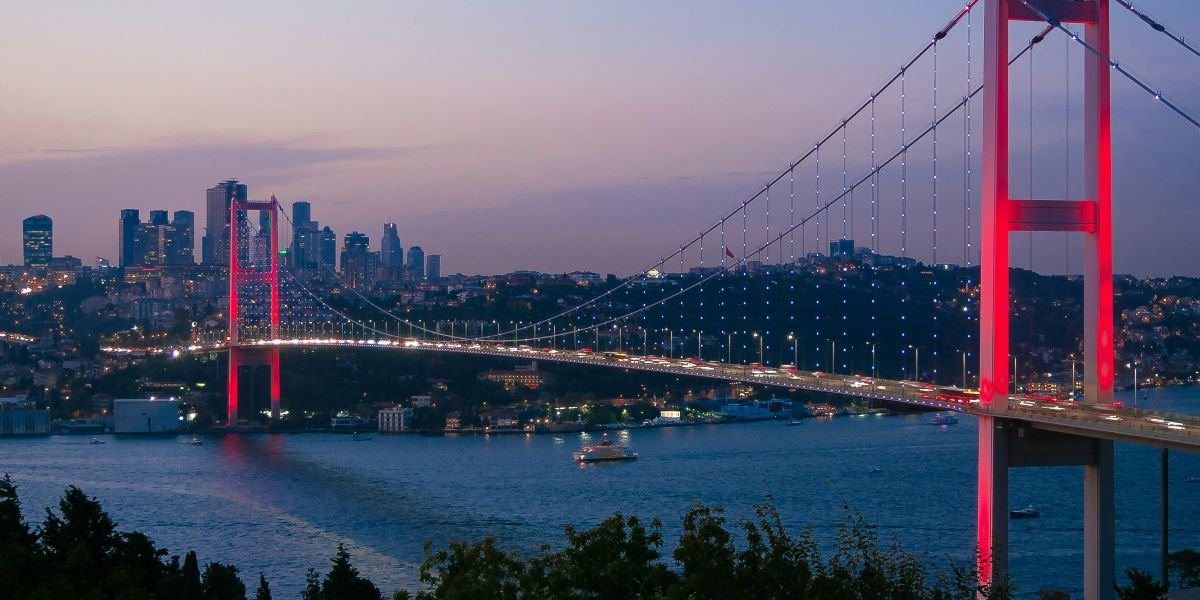
A commuter in Istanbul can begin the morning in Asia, board a ferry, and step off minutes later in Europe without leaving the city limits. That daily crossing captures what makes the Turkish metropolis unusual among the world’s great cities: it sits on two continents at once, split by a narrow waterway that has shaped its fortunes for more than two and a half thousand years.
A City Divided By Water
The boundary running through Istanbul is the Bosphorus Strait. The strait is about 35 kilometers long and connects the Black Sea in the north to the Sea of Marmara in the south, dividing the city as it goes. One bank lies in Europe, the other in Asia, and the channel itself forms part of the recognized continental boundary between the two.
The split is not even. The European side holds the larger share of the city and most of its landmark monuments, and that side is further carved by an inlet called the Golden Horn. The Asian side is more residential, and a substantial portion of the population lives there. As of 2024, Istanbul ranks as the world’s fifth-largest city proper and remains the largest city in Europe, with roughly a third of its residents living on the Asian shore.
The Only Metropolis Of Its Kind, With Caveats
Istanbul is frequently described as the only city on two continents, and for a major urban center the claim holds. The fuller picture is more precise. Other cities also straddle a continental line, including the Russian cities of Orenburg and Magnitogorsk, Atyrau in western Kazakhstan, and Suez in Egypt, which sits between Africa and Asia, but Istanbul is by far the largest and the only metropolis to do so.
That distinction matters because Istanbul’s transcontinental character is not a geographic technicality. It is a city of around 15 million people functioning across the divide, with neighborhoods, economies, and daily commutes spread over both Europe and Asia. The smaller transcontinental towns do not operate at anything close to that scale.
Why The Location Mattered For Millennia
The site’s value was obvious long before modern borders. The Bosphorus is the only maritime route linking the Black Sea to the Mediterranean, by way of the Sea of Marmara and the Dardanelles, which made whoever controlled it a gatekeeper of trade and naval movement. Because of its strategic position between Europe and Asia, the city controlled the route between the two continents and the passage between the Mediterranean and the Black Sea.
That control underwrote centuries of wealth and conflict. The city changed hands and names as empires rose and fell. Founded by Greek settlers as Byzantium around the seventh century BCE, it was later rebuilt as Constantinople and served as the capital of the Byzantine and then the Ottoman Empires, remaining one of the most contested cities in the world for much of that span.
How “Constantinople” Became “Istanbul”
The modern name has an everyday origin. Greek speakers referred to trips there as “eis tēn polin,” meaning “into the City,” and over centuries that phrase evolved through speech into the name Istanbul. The change became official relatively recently. The Turkish capital had already moved to Ankara when the republic was proclaimed in 1923, and the city’s name was formally changed from Constantinople to Istanbul in 1930.
Bridging The Continents
For most of history, crossing between the two sides meant taking to the water. That changed in the modern era as the city built fixed links across the strait. Today three suspension bridges span the Bosphorus, beginning with the first completed in 1973 and most recently the Yavuz Sultan Selim Bridge finished in 2016. Two tunnels, a rail crossing opened in 2013 and a road tunnel completed in 2016, run beneath the water to ease the city’s heavy traffic.
The crossing has even become a sporting event. An annual cross-continental swimming race lets participants swim from the Asian shore to the European one, a literal passage between continents that few other places could stage.
For all its bridges and tunnels, the strait remains the defining feature of the city. It has acted, in different eras, as both a barrier and a bridge, separating armies and joining trade routes. The geography that once made Istanbul one of the most fought-over places on Earth now makes it a singular modern city, one where a short ferry ride carries passengers not just across a harbor but between two continents, a routine commute that doubles as a crossing of the line where Europe meets Asia.